
 Buy Crypto
- Markets
 Futures
- Spot
- Copy Trade
- Earn
- More
$55,000 will be Bitcoin's make-or-break level

Original Title: BTC Is On The Edge Of Glory... Or Death
Original Author: Dom, Crypto Analyst
Translation: Luffy, Foresight News
Last week, the price of Bitcoin briefly touched $60,000. Under the stock-to-flow model, this is far from mere noise. The market is touching the most fragile part of the entire four-year cycle and the logarithmic growth curve.
When the rally at the top of the Bitcoin cycle has already been significantly compressed, if a historically deep pullback occurs once again, the classic cycle's allure will be completely nullified.
This is not a prediction; this is mathematical law.
Rally at Cycle Top is Compressing
Bitcoin historical cycle tops:
· 2013: ~$1,242
· 2017: ~$19,700
· 2021: ~$69,000
· 2025: ~$126,000
Multiplier of rally between cycle tops:
· 1,242 → 19,700 = 15.9x
· 19,700 → 69,000 = 3.5x
· 69,000 → 126,000 = 1.8x (historically the weakest)
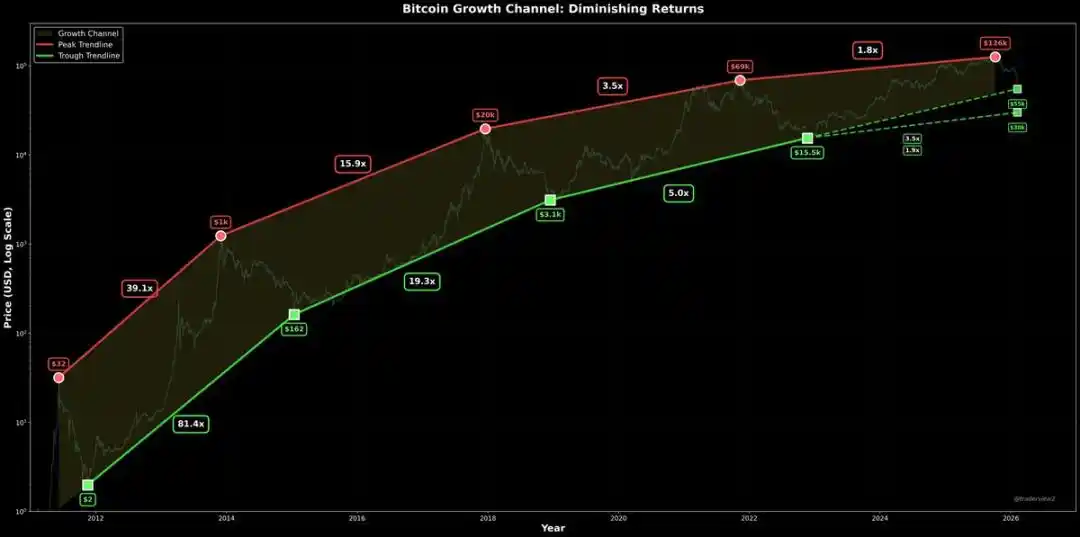
This 1.8x multiplier says it all. Compared to history, the upside potential of this cycle is minimal. This structure cannot withstand a significant drop; otherwise, Bitcoin's growth will completely plateau.
This 1.8x rally is the core truth of the current market. Compared to historical levels, Bitcoin's upward potential is now extremely narrow. This cycle structure cannot withstand a deep retracement; otherwise, Bitcoin's long-term growth trajectory will be completely stalled.
Pure Mathematical Constraint Formula
Definition:
· m = Cycle Peak Multiplier = Current Cycle Peak ÷ Previous Cycle Historical High
· d = Retracement from Peak Ratio (in decimal form)

Therefore, the bottom of the next cycle relative to the peak of this cycle is equal to the peak multiple times the remaining price ratio after the retracement.
If we want the bottom of the next cycle to be no lower than the previous cycle's all-time high, we need to meet the following conditions:
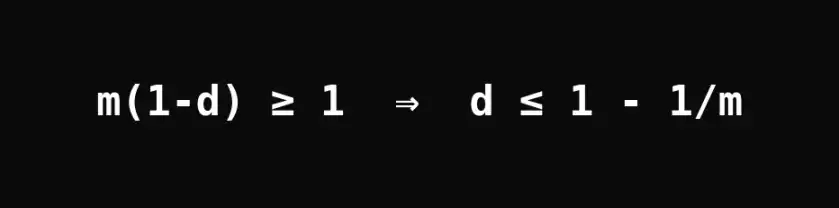
By inputting the current cycle's data, with the previous all-time high at around $69,000 and the current cycle's peak at around $126,000, we can conclude:
The peak multiple of this cycle is around 1.8 times. To maintain the bull market structure intact, the maximum allowed retracement is about 44%, a threshold that Bitcoin has already exceeded.
Dropping from around $126,000 to $60,000, Bitcoin's retracement has surpassed the 44% "safe limit" mentioned above.

This means that if the previous all-time high should have acted as structural bottom support, the current market has forcefully broken below this support, forcing the market to give a final verdict.
$55,000 is the Key Line Between Life and Death
If Bitcoin drops to $55,000, two key signals will emerge:
· A retracement of 56%, far beyond the 44% allowable upper limit
· The bottom price will be 20% below the previous all-time high ($69,000)
If the price continues to stay below $55,000, it means the market acknowledges that in a weak cycle with only a 1.8x increase, the cycle's bottom can be significantly below the previous all-time high.
The subsequent impact will be that if the next cycle still maintains a 1.8x multiple, the Bitcoin price will rise from $55,000 to $99,000. The long-term growth trajectory will stall. This is essentially a structural failure of the growth model, and the market must make a change.
This is the current core contradiction: Bitcoin's upside potential has been greatly reduced, but the volatility has not decreased accordingly. It is still a highly volatile market, but the peak gains have significantly shrunk. Such a cyclical pattern is simply unsustainable.
Technical Support Near $55,000
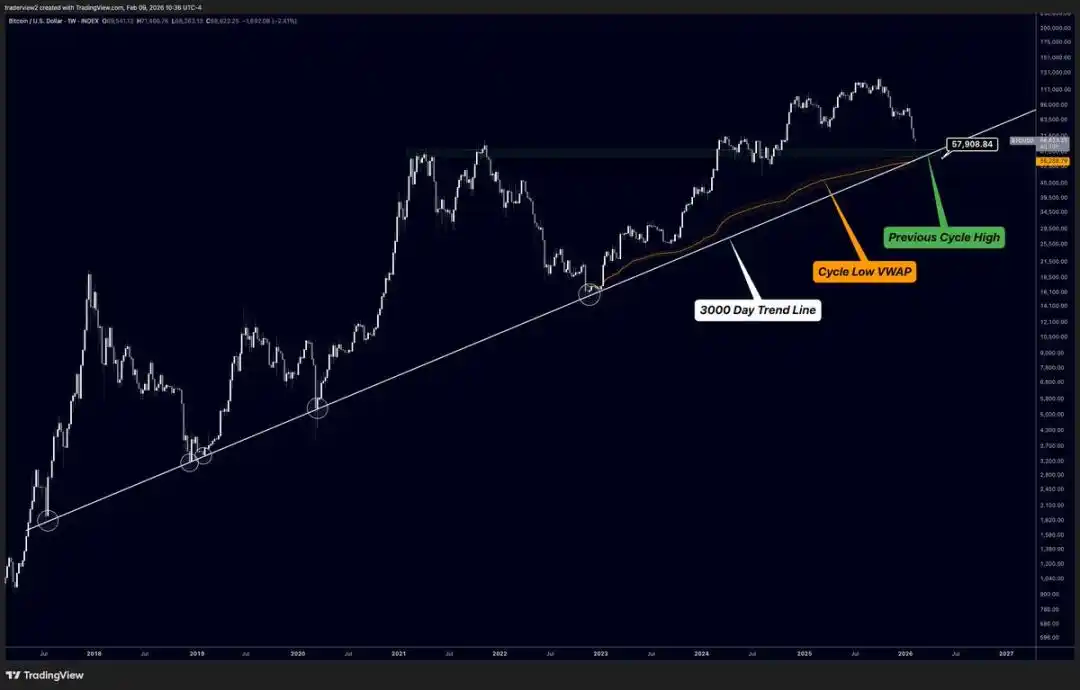
From a technical perspective, the mid-$55,000 range has strong structural support, including:
· 3000-Day Trendline (Spanning Over 8 Years)
· 2022 VWAP of Cycle Low
· Extension of Support from Previous Cycle's All-Time High ($69,000)
Let's consider: Why would an asset built on the belief of "long-term ultra-high returns" break below this multi-year accumulation of triple structural support? Especially when convenient investment vehicles like ETFs have already been established, this kind of movement is in complete contradiction to the long-term growth trajectory.
The Cliff of Risk-Adjusted Returns
This contradiction has made the entire Bitcoin cycle logic binary: If the peak multiple of the cycle continues to shrink while the pullback magnitude does not decrease proportionally, Bitcoin's risk-return ratio will deteriorate completely:
· Potential upside within the four-year cycle is only 20% to 50%
· Downside, however, could still reach 50%
· Cycle trading will lose all meaning.
Faced with this dilemma, the market has only three ways out:
· Significant volatility contraction (Toward Glory)
· Complete failure of the four-year cycle framework (Toward Destruction)
· Emergence of an entirely new demand driver, resetting the growth curve and ending the trend of continuous diminishing multiples
While ETFs are the most commonly mentioned potential driver in the market, ETFs have already been established. To truly reset the growth curve, three types of forces are needed: large-scale structural fund allocation, adoption at the sovereign state level, or sustained and price-insensitive rigid demand.
The Harsh Reality: Why This Cycle Is So Different
When I entered the crypto market in 2017, the entire industry was full of hope and innovative energy, with people believing that these blockchain networks could truly bring real solutions to the world.
Nearly nine years later, it's hard to argue that any large-scale crypto ecosystem has truly achieved sustainable mainstream utility value that matches the initial promises.
This cycle has harvested numerous participants, with almost no performance from the vast majority of tokens. More and more people are starting to realize the truth of the market: for the vast majority of crypto assets, this is fundamentally a PVP game, where participants rely on leverage, liquidation, and capital rotation to gain profits from other participants, rather than relying on the asset's inherent value appreciation.
The market's filtering rule has never failed: in the long run, the vast majority of cryptocurrencies will eventually go to zero. However, Bitcoin, along with a few high-quality assets in the crypto space, still have the opportunity to break out of this fate and achieve a true value breakthrough.
The Choice Between Glory and Doom
The Road to Glory
Bitcoin achieves a "breakthrough upgrade": volatility significantly shrinks, retracement levels are far below historical levels, and the previous historical high zone has once again become a solid structural support. Despite the reduction in the cycle peak multiple, the asset's stability has significantly improved, the risk-reward ratio has been greatly optimized, truly becoming a sustainable long-term investment target.
The Road to Doom
The four-year cycle framework has completely failed. It is not Bitcoin itself that disappears but rather the long-standing cycle logic that no longer holds. Although volatility remains at historically high levels, the upside potential continues to shrink, the previous historical high point no longer acts as a bottom support, and the previous growth channel has become a historical relic. In the future, Bitcoin may still experience periodic uptrends or continue to see applications implemented. However, the previous cyclical patterns will no longer be the dominant rule of the market.
The Road to Reset
A new strong demand-driven force has emerged, completely breaking the model of diminishing growth multiples and reshaping Bitcoin's growth curve. This may come from large-scale structural fund allocations, widespread adoption by sovereign nations, or passive institutional buying forming long-term support.
Another Hidden Danger: Long-Term Test at the Protocol Level
This is not currently a core factor affecting the market, but it is worth long-term attention: in the long run, Bitcoin must prove that it can evolve at the protocol level, especially with quantum resistance. The core of the quantum issue concerns Bitcoin's ownership security and protocol upgrade coordination, rather than mining itself. The security of early Bitcoin (such as Satoshi Nakamoto's holdings) is the true potential threat.
If Bitcoin hopes to become a long-term asset, it must ultimately pass the test of "completing protocol upgrades without destroying market trust." This is like a background timer that has not yet been triggered but is always a significant hidden danger for Bitcoin's long-term development.
Simple Judgment Criteria
If, after the shakeout, Bitcoin reclaims and stabilizes above $69,000: the cyclical structure is preserved, and the path to glory still has a good chance.
If Bitcoin's price remains in the range of $55,000 to $69,000: the market is under maximum pressure, and the cyclical model faces its final test.
If the Bitcoin price remains below $55,000: In a weak cycle background with a 1.8x peak multiplier, a structural breakdown occurs, indicating a high probability of a fundamental shift in the market structure.
Conclusion
Bitcoin cannot simultaneously maintain two traits in the long run: a low-growth asset and a high drawdown asset. If risk-adjusted returns still make sense, the two cannot coexist in the long term.
With Bitcoin currently touching near $60,000, the market is real-time testing this life-or-death boundary. Once the price falls below the $50,000 range, all debates will cease, and the market will provide the final verdict, either heading for glory or plunging into destruction.
You may also like

The New Yorker in-depth investigation interpretation: Why do OpenAI insiders consider Altman untrustworthy?
Two Divided Worlds: Insights from the New York Digital Asset Summit, the Most Institutionalized Blockchain Conference

Top Ten Reveals of CZ's New Book: Advance Knowledge of "94", the Inside Story of Huobi's Change of Ownership Made Public for the First Time

Ceasefire Overnight Erases War Premium, Three Fault Lines Only One Sealed | Rewire News Morning Brief

Robinhood Secures 'Trump Account': Enabling Millions of Newborns to Access the Stock Market

Afraid to Open the Pandora's Box? Anthropic's Most Powerful Model Ever Dares Not Be Disclosed

US-Iran Ceasefire: A Temporary Pause or Prelude to Renewed Conflict? Market Outlook for Oil, Gold, and Bitcoin
April 8, 2026 – A temporary ceasefire between the U.S. and Iran has provided some immediate relief to the global markets, but the fundamental question remains: Will the cessation of hostilities hold, or is this merely a brief reprieve before a resumption of conflict? As the situation unfolds, market observers are closely monitoring how key assets like oil, gold, and Bitcoin will react in the coming weeks. This article explores whether the ceasefire is a sign of lasting peace, assesses the short-term market implications, and delves into the evolving role of Bitcoin in the global financial landscape.

WEEX Market Update: U.S.-Iran Ceasefire Sparks Bitcoin Price Surge
April 8, 2026 – In a significant shift in global geopolitics, U.S. President Donald Trump has announced a temporary two-week ceasefire with Iran, resulting in a notable market reaction across various asset classes. This development comes after discussions between Trump, Pakistani Prime Minister Shahbaz Sharif, and Army Chief General Asim Munir. The announcement is already reverberating through markets, particularly in oil, gold, and cryptocurrencies.
Morning Report | South Korean financial institutions pilot stablecoin payments for foreign users; Morgan Stanley Bitcoin ETF is about to be listed; CME plans to launch AVAX and SUI futures contracts

EigenCloud Founder: AI and Cryptocurrency are Creating the Next Trillion-Dollar Asset Class
From Panic to Pumps: How Bitcoin Traders Are Playing the 2-Week US-Iran Ceasefire
For most people, the two-week US-Iran ceasefire is about geopolitics, oil prices, and whether World War III gets postponed. But for crypto traders glued to their screens late Sunday night, it was something else entirely: the clearest risk-on signal in months.

US-Iran Ceasefire Triggers Oil Plunge, Bitcoin Surge, and Gold Rally
Despite the sharp rally, caution is warranted. The $70,000–$72,000 zone has historically been strong resistance. The ceasefire is only temporary (two weeks), and any breakdown in negotiations could trigger a sell-off toward the $62,000–$65,000 support zone. For now, Bitcoin needs to close decisively above $72,500 to confirm a true breakout; failure to do so within 48–72 hours could lead to a swift retracement.

OpenAI has no "New Deal," a blueprint for AI that refuses to pay.

Wall Street Flash Mob Run? Mega-Cap Stock Plunge, Goldman's Great Escape, Illustrated Guide to Private Credit Crisis

OpenAI Feud: Power, Trust, and the Uncontrollable Boundaries of AGI
「AI Doomsday Cult」 Sends Operatives into the Strait of Hormuz: What Did They Find?
Everyone is waiting for the war to end, but is the oil price signaling a prolonged conflict?


 App
App