
If the US and Iran have not reached an agreement in 5 days, what other cards does Trump have?

 Prefer us on Google


On March 23, Trump announced a 5-day postponement of the strike on Iran's energy infrastructure, claiming there had been "very good, productive dialogue" and "significant points of agreement" between the US and Iran. Following the news, Brent crude oil dropped from $112 to $99.94, a one-day plummet of 10.92%, marking the largest single-day drop since the start of Epic Fury.
However, Iranian Speaker Ghalibaf denied that any direct negotiations had taken place that day. Turkey, Egypt, and Pakistan acted as intermediaries to relay messages, with Kushner and Wittkov coordinating, but there was a disagreement on whether actual talks were happening.
On the Iran issue, this was not the first time Trump had issued a "final warning" and then backed down. From 2018 to the present, a similar pattern has emerged 7 times.
7 Threats, 2 Fulfillments
Looking at all significant threats Trump has made to Iran from 2018 to date, the pattern is clear.
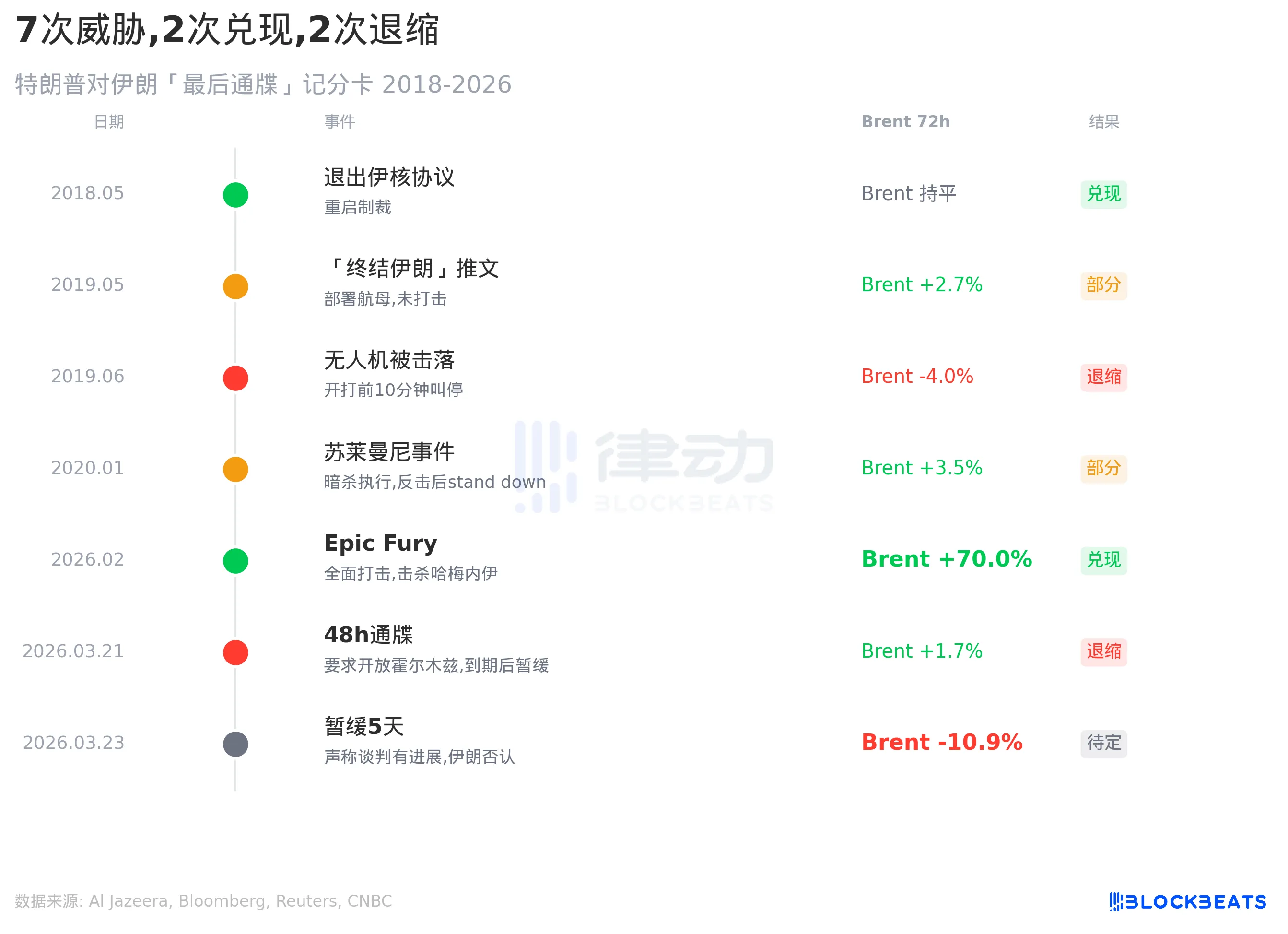
In 2018, he withdrew from the Iran nuclear deal, as promised, and sanctions were reinstated as scheduled. In February 2026, he launched Epic Fury, also following through, killing Soleimani within 24 hours and destroying over 70% of Iran's missile launchers (according to Israeli intelligence assessment). These two instances were completely fulfilled, resulting in a sharp oil price reaction. Epic Fury caused Brent to soar from $71 to $119.50, a 70% increase.
However, the flip side is equally noteworthy. In June 2019, after Iran shot down a US drone, Trump ordered strikes on Iranian radar and missile sites, with the military "cocked and loaded," but called off the strike 10 minutes before it commenced. On March 21, 2026, a 48-hour ultimatum was issued to Iran to reopen the Strait of Hormuz, but instead of an attack after the deadline, it turned into a "5-day postponement."
Out of the 7 instances, 2 were fully carried out, 2 were partially executed, 2 were retreated from, and 1 is pending. The market reaction has also varied. After the halted strike in 2019, the oil price only fell by 3-5%. This time, with a 5-day postponement, the oil price directly dropped by 10.92%. The market's response to signals of "postponement" is intensifying, as investors are increasingly quick to price in the "devaluation of threats."
What Does a $100 Oil Price Signify
After the 5-day window expires, there are three possible scenarios.
The first scenario is reaching some framework agreement. It may not be a comprehensive agreement, more likely a temporary freeze of 30-60 days to buy time for further negotiations. In this scenario, Brent may fall back to the $80-90 range, approaching Goldman Sachs' 2026 average price forecast of $85.
Secondly, postpone and continue to negotiate. After the 5-day deadline expires with no deal or signature, enter a new deferment window. Oil prices remain range-bound between $95-110, with the war risk premium neither dissipating nor intensifying.
Thirdly, resume strikes along with a continued blockade of the Strait of Hormuz. According to CSIS's scenario model, if Iran were to escalate attacks on Gulf oil facilities following a strike, Brent could spike to $130-150. Goldman Sachs's extreme scenario is more aggressive: if the Hormuz blockade persists for 60 days and Middle East production permanently decreases by 2 million barrels/day, oil prices could surpass the historical high of $147 in 2008.
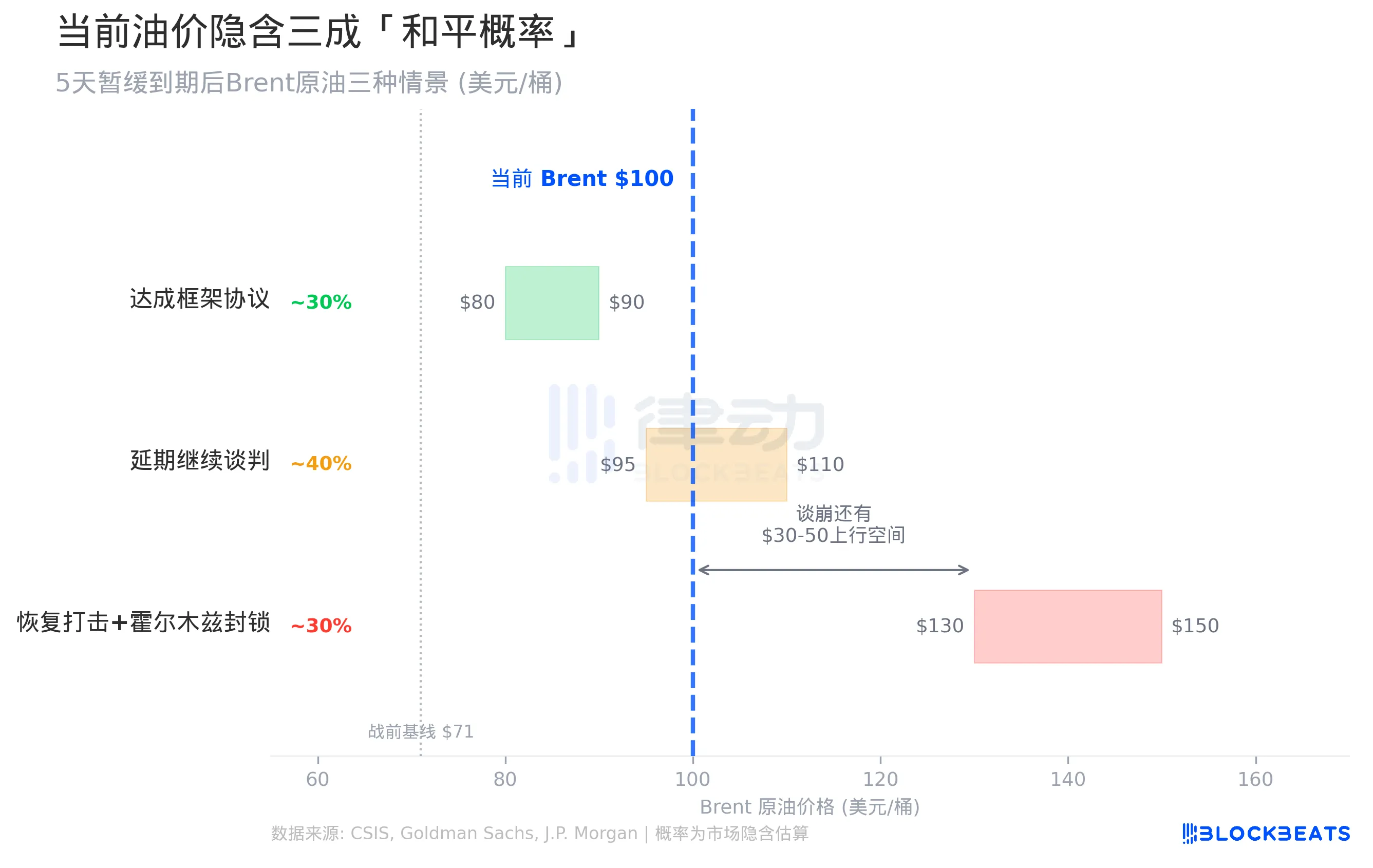
With Brent currently priced at $100, it roughly implies a 30-40% probability of the "deal being reached." In other words, the market believes there is a 60-70% chance that the situation will not fundamentally improve after 5 days. If the talks collapse, oil prices could have upside potential of $30-50.
The 2015 Negotiations Took 35 Months
Trump's six core demands include zero uranium enrichment, dismantling nuclear facilities, a 5-year freeze on missile development, ending support for proxy militias, recognizing Israel's right to exist, and having the U.S. physically take over Iran's high-enriched uranium stockpile. These demands far exceed the 2015 JCPOA framework, which only limited enrichment levels to 3.65%, kept facilities operational, and did not involve missiles or proxy militias.
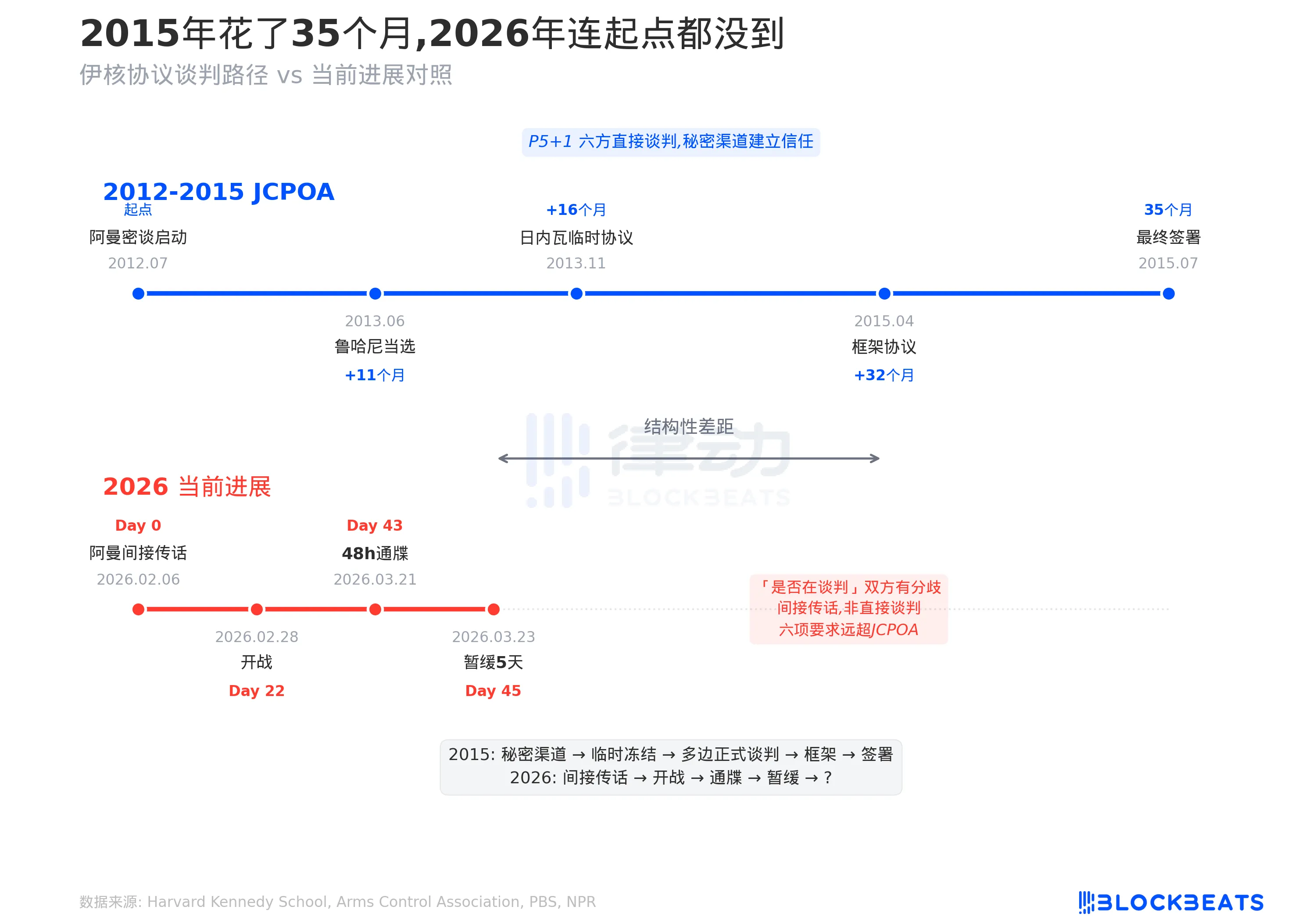
The 2015 JCPOA, from the July 2012 secret talks in Oman to the final signing in Vienna, took a total of 35 months. It went through pragmatic elements coming to power due to Rouhani's election, building trust through the Geneva Interim Agreement, and 20 rounds of direct talks among the P5+1 nations.
Where do things stand in 2026? There was an indirect message in Oman on February 6, followed by war breaking out on February 28. By March 23, just 45 days later, the temporary ceasefire is in place, with both sides contradicting whether they are even in talks. The mediatory structure involves Turkey, Egypt, and Pakistan shuttling messages instead of the P5+1 engaging in multilateral direct negotiations. The prerequisite conditions for talks (acknowledgment by both sides of the talks' existence) have not been met, whereas the 2015 path first established over a year of trust through a covert channel before entering open negotiations.
-- Price
If Talks Fail, What Other Cards Does Trump Have?
The military option is the most direct. A power plant strike is a 5-day direct target with the lowest threshold for recovery operations. More escalated options include a blockade or occupation of Kharg Island, reportedly discussed in a plan as of March 20, according to Al Jazeera. Kharg processes 90% of Iran's crude oil exports, around 1.3-1.6 million barrels per day (according to EIA data). Regarding nuclear facilities, Natanz was damaged in the first week of the war, Fordow still holds high-enriched uranium unrelocated since its strike in June 2025 (per FDD analysis), but the new Pickaxe Mountain facility built by Iran 100 meters under a granite mountain near Natanz is beyond airstrike capabilities. Currently, the U.S. has deployed 2 carrier strike groups, over 16 surface ships, and more than 100 aircraft in the Middle East, as reported by Military Times, marking the largest scale since the Iraq War in 2003.
On the economic front, Trump declared a 25% tariff in January on countries doing business with Iran. The main targets are China (which accounts for over 90% of Iran's oil trade), as well as India, the UAE, and Turkey. Iran's current oil exports stand at 1.5-1.6 million barrels per day, with daily revenue around $140 million (based on Defense News data).
Cyber warfare is already underway. According to Foreign Policy, prior to the kinetic strike of Epic Fury, the U.S. Cyber Command had already initiated "non-kinetic effects," paralyzing some of Iran's communication and early warning systems.
However, Iran also holds its counterplay cards. As assessed by the U.S. Defense Intelligence Agency (DIA), Iran could sustain a blockade of the Strait of Hormuz for 1-6 months. The strait sees 20 million barrels of crude oil and petroleum products pass through daily, accounting for 20% of global oil consumption (per EIA data), while Saudi Arabia and the UAE only have a pipeline bypass capacity of 3.5-5.5 million barrels per day, leaving a gap of up to 14.5 million barrels per day. Iran still has about 1,500 ballistic missiles and 200 launchers (as estimated by the Israeli military), and Hezbollah is believed to have around 25,000 missiles (per Israeli assessments).
This is the underlying logic of the 5-day window power play. Trump faces a credibility trap: to strike would risk spiraling oil prices and domestic economic pressure. Not to strike would further erode the pricing power of military threats in the cycle of ultimatums and deferrals. Iran's dilemma is symmetrical: to negotiate would be opposed by domestic hardliners. Not to negotiate could lead to the next targets being power plants and Kharg Island. The deadline of March 28 is not the endpoint but the next turn of this trap.
This content is provided for general informational purposes only and doesn't constitute financial, investment, legal, or tax advice. Any events, rewards, online promotions, or related information mentioned herein should not be considered a recommendation, solicitation, or invitation to purchase, sell, trade, or otherwise deal in any crypto assets. Crypto assets are highly volatile and may result in loss. The availability of WEEX services, products, and related events may vary by region. You are responsible for ensuring that your participation is in accordance with applicable local laws and regulations.
You may also like

Trump: Bombing will begin if Iran does not agree to the deal

Trump Signals Conclusion of Iran Conflict and Market Ripples
Key Takeaways: Oil prices surged past $100 a barrel amidst Trump’s speech about the winding down of the…

29 Days In, What Are America’s Options on Iran?

Trump plans to consider increasing troops in the Middle East while evaluating ground action options

Wintermute: If the conflict continues, cryptocurrencies and other risk assets may remain under pressure

Caixin Reveals Chen Zhi's Domestic Assets: Holds Shares in Two Listed Companies, Plus Multiple Financial Institutions
Chile Requests the Extradition of Two Venezuelans Who Laundered Nearly USD 19 Million for the Tren de Aragua

Crypto investors should favor systematic strategies over Fed predictions, Moon Pursuit Capital says
MEXC stock futures trading volume in Asia surges over 3,300% in Q2

Operation Lighthouse: 14,000 Leads Delivered to Investigators Against Child Exploitation Networks
Binance founders used ‘The Simpsons’ codenames, former employees share

Crypto: Solana ETFs Record Their Biggest Day of the Year

Ray Dalio Warns of U.S. Debt Crisis and Recommends Gold and Bitcoin as Protection
Xbox and PlayStation Reassess Their Multiplatform Strategy, Emphasizing Exclusivity Again

The new Resident Evil movie will bring action to the first person
What is the cost of cheap borrowing?

Interview: Aptos CEO on AI Agents, Stablecoins, and Machine Commerce

Chainalysis identifies 7,700 suspect accounts in CSAM crypto operation
Ledger Wallet Vulnerability; Users Must Update Ethereum App to Version 1.22.2
AI: Hugging Face explores a sale that could value it at $13 billion
Why major crypto asset manager’s 25% buyback plan might recycle shares to employees instead of shrinking supply
Previously Bearish on Crypto Market, Jiang Zhuoer Quickly Turns Bullish: Ethereum is the Engine of the Bull Market
Trump Proposes a $1,700 Tax Credit to Boost School Choice in the U.S.

Linux 7.3 Expands Support for New RISC-V Extensions
Mozilla prepares default JPEG-XL support in Firefox 157
GNU Emacs 31.1 Enables Mouse Control by Default in Terminals
Grayscale Launches Zcash ETF Following Critical Privacy Flaw That Rocked the Cryptocurrency

Stellaria Raises $6.8 Million at a Valuation of $114 Million
Some Bitcoin holders tax bill is now set when they leave the country instead of when they sell

Michael Saylor Targets Bitcoin Orthodoxy: 'Satoshi Is Not a Prophet'
Trump: Bombing will begin if Iran does not agree to the deal
Trump Signals Conclusion of Iran Conflict and Market Ripples
Key Takeaways: Oil prices surged past $100 a barrel amidst Trump’s speech about the winding down of the…
29 Days In, What Are America’s Options on Iran?
Trump plans to consider increasing troops in the Middle East while evaluating ground action options
Wintermute: If the conflict continues, cryptocurrencies and other risk assets may remain under pressure
Caixin Reveals Chen Zhi's Domestic Assets: Holds Shares in Two Listed Companies, Plus Multiple Financial Institutions

Contents
Latest articles


Latest coin listings on WEEX


