
- Buy Crypto
- Markets
 Futures
- Spot
- Copy Trade
- Earn
- More
What's Next for the Top Zcash Fork in This Round of Mimicry?

Over the past 2 months, ZEC, which has surged nearly 10x and followed its own independent trend, has always been the focus of the market. The logical discussions surrounding ZEC have gradually evolved from early endorsements of privacy concepts by figures such as Naval, Arthur Hayes, and Ansem, to a stage where the debate is between the bullish view based on real privacy use cases and the bearish view based on coin hashrate and mining rewards.
So, apart from endorsements by well-known figures, what are the detailed arguments for the bullish and bearish views on ZEC?
Bullish View
Regulation-Induced "Safe Haven Premium"
At first glance, regulatory tightening may seem to suppress privacy coins, but in reality, it is the opposite; it is precisely due to regulatory pressure that the demand for privacy is being stimulated.
Regulatory tightening at the policy level is accelerating. The draft of the EU's Anti-Money Laundering Directive clearly states that by 2027, privacy coins will be completely restricted from transactions within the EU; the U.S. Financial Crimes Enforcement Network (FinCEN) is also planning to enhance scrutiny of "high-risk self-hosted wallets." With Bitcoin and Ethereum spot ETFs coming into the regulatory spotlight, all on-chain transactions are facing stricter tracking.
As compliant assets become more transparent, privacy assets become scarce. Therefore, Western media has even named this round of the market movement "Crypto Anti-Surveillance Wave." ZEC and XMR have been redefined as the "last line of on-chain anonymity defense." The consensus on social media is more direct: "Privacy is not a feature but a fundamental right."
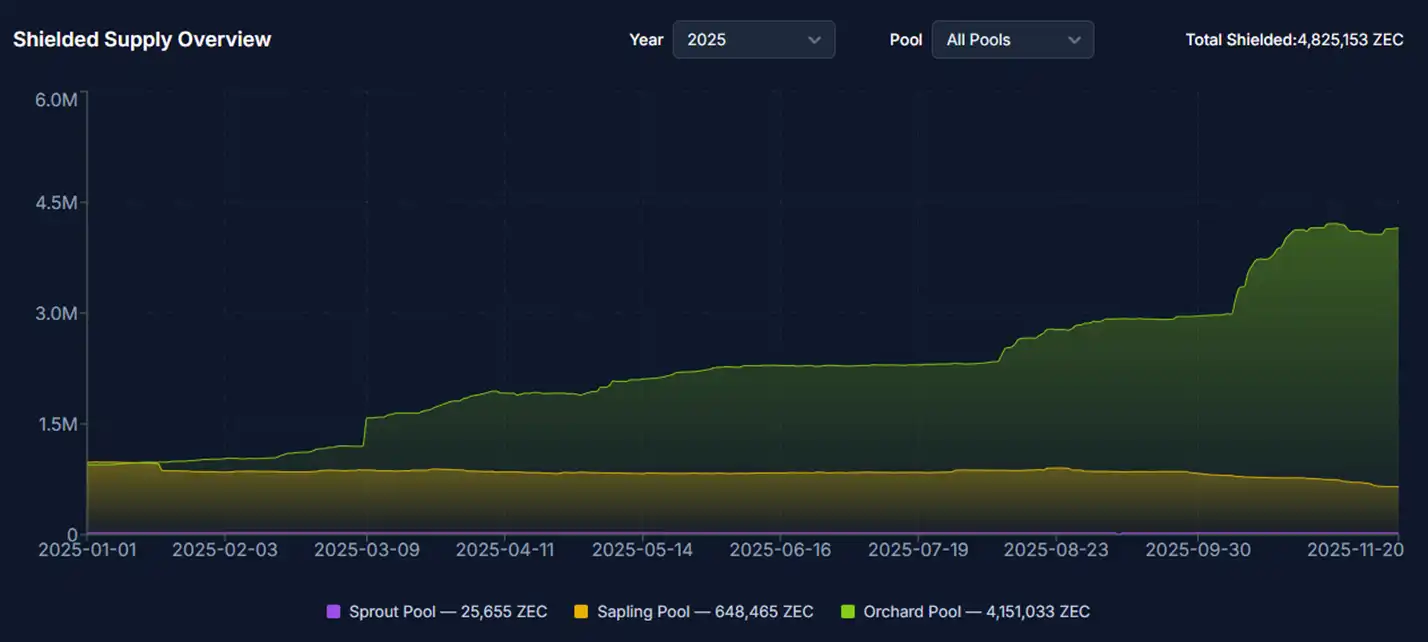
On-chain data confirms the growth of real demand. ZEC shielded pool balances have grown from just under 2 million coins at the beginning of this year to approximately 4.8 million coins today, an increase of 140%; shielded transaction counts have also increased with the overall network activity, reaching approximately 10% weekly.
In the recent two major "BTC Whale Asset Cases," the cases of Chen Zhi and Qian Zhimin, a total of over 180,000 BTC involved has prompted the market to reevaluate Bitcoin's real boundaries in narratives such as "anti-surveillance" and "anonymity." With the launch of BTC ETFs, deep institutional involvement, and further regulatory demands for transparency in the crypto asset sector, Bitcoin's early narrative centered on anonymity and anti-surveillance is gradually fading from the mainstream stage.
If BTC also struggles to maintain its role as an "anti-surveillance currency," then who will be the next symbol of privacy and on-chain asset storage? The market's answer may have already emerged—ZEC, which is currently moving against the trend at this point in time, is becoming the suitable "answer version."
Institutional Money Returning
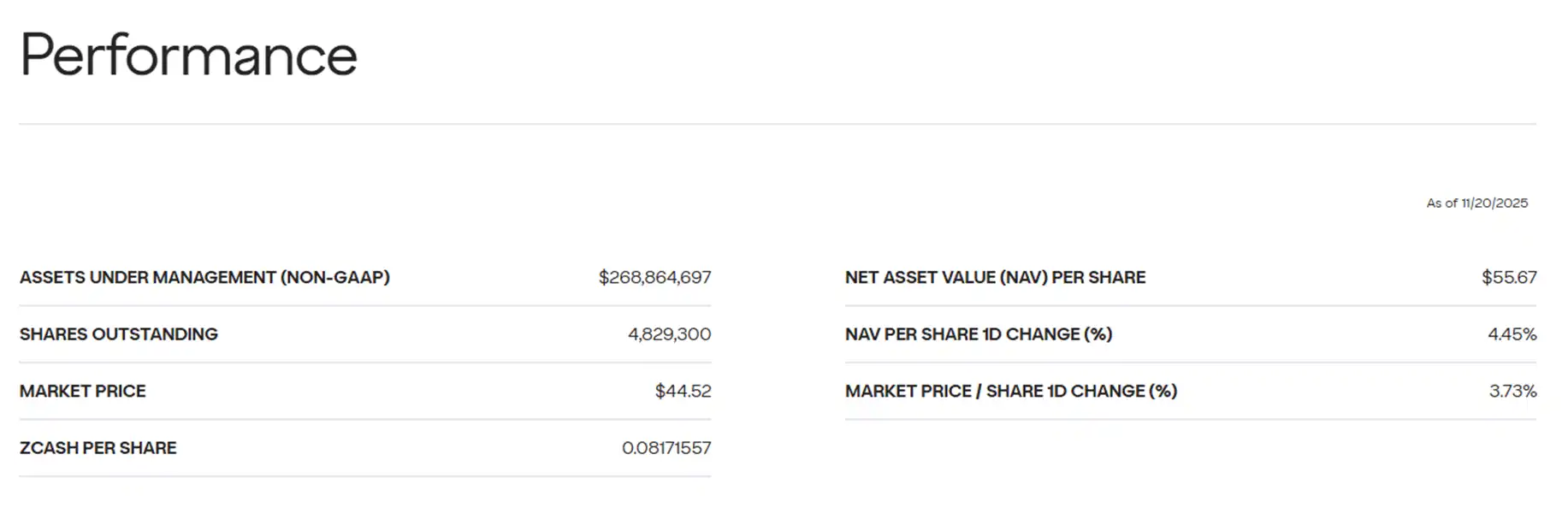
Grayscale's Grayscale ZEC Trust relaunch was the most significant event in October. On October 1st, Grayscale announced the reopening of new subscriptions for the ZCSH Trust, offering two major upgrades: first, a waiver of management fees, and second, the addition of staking functionality, providing a 4-5% annualized yield. This one-two punch significantly improved the risk-return ratio.
Over the past decade, Grayscale has been almost the sole compliant bridge and price oracle for traditional institutional exposure to crypto assets. Its trusts issued in the U.S. have long provided crypto exposure to pensions, family offices, and hedge funds, making it a leading indicator of institutional entry scale and preference shifts.
Since launching its first Bitcoin trust in 2013, Grayscale has subsequently expanded to ETH, SOL, LTC, BCH, ETC, FIL, XLM, and over a dozen single-asset trusts. Several assets have experienced the typical "Grayscale Effect" — capital inflows driving price appreciation, premium expansion, and consensus narrative formation. The ZEC Trust (ZCSH) was established in 2017 and also experienced a surge in premium during the 2020-2021 bull market, becoming a key target for institutional allocation in the privacy sector.
However, due to increased regulatory scrutiny and privacy coins facing compliance pressures, ZCSH paused subscriptions in 2022 and went into dormancy in 2023. This relaunch signifies Grayscale's renewed endorsement of privacy assets, with its signaling significance often outweighing the actual funds.
Data shows that ZCSH's Assets Under Management (AUM) have increased from around $42 million just over a month ago to $269 million, representing approximately 2.4% of ZEC's circulating supply. For an asset with daily trading volumes in the billions of dollars, nearly 2.5% of the chips are long-term locked in the trust, leading to significant supply-side constraints.
A deeper logic is the ETF's circuitous effect. The approval of Bitcoin and Ethereum spot ETFs has brought these assets into a stringent regulatory framework with every transaction being traceable. Some institutions and high net worth individuals, to avoid this transparency, are starting to divert funds to anonymous assets. Grayscale's ZEC Trust conveniently offers a compliant channel — providing exposure to a privacy coin while operating through traditional financial channels.
Bear Case
Is ZEC's miner economic model, network security, and on-chain activity truly robust enough to support a market capitalization of over $100 billion? Lacie (@Laaaaacieee) raised this question and conducted a thorough analysis.
The Extremely Short Payback Period (Ultra-High ROI) Is Often a Precursor to Mining Difficulty and Price Collapse
Based on the calculation of the payback period for ZEC mining using the most mainstream ZEC miner, the Bitmain Antminer Z15 Pro, each Z15 Pro unit's daily net income exceeds $50. The Z15 Pro's static payback period is only about 105 days, resulting in an annualized return rate of nearly 350%. Furthermore, historical data shows that such high returns have been sustained for at least a week.
Lacie points out that this figure is extremely rare throughout the entire PoW history—it can even be considered abnormal:
- The payback period during the BTC miner's uptrend usually takes 12–24 months
- The ROI for ETH's PoW-era miners ranged from 300 to 600 days
- PoW projects with payback periods of less than 120 days in history (such as FIL, XCH, RVN, etc.) almost all collapsed after several months
Lacie also reviews the recurring Hardware–Price Scissors scenario, as seen in Chia and KAS. The Hardware-Price Scissors is a recurring "harvesting" script in mining history in which miners, at the peak of the coin price and heavy FOMO sentiment, order miners at a multiple premium price (where ROI appears extremely low, with only a 4-month payback period). However, when the miners are actually delivered and put into operation, with a sharp rise in hash rate (often delayed by over 3 months), whales often sell at a high point, causing miners to face a double blow of "halving of coin price + halving of output," turning their miners into expensive scrap metal in an instant.
Network Security Issues Caused by Hashrate Scale
Lacie points out that according to the latest network data, ZEC's total network hashrate is approximately 12.48 GSol/s. Calculated based on a Z15 Pro's hashrate of 0.00084 GSol/s, it would only require about 14,857 Z15 Pro miners, with an energy consumption of approximately 40 MW, which is equivalent to the scale of a medium-sized Bitcoin mining farm. Generally, a 51% attack requires controlling over 50% of the network's hashrate at the same time. If nearly 1.6w Z15 Pro miners form the core of the ZEC network, an attacker would only need to rent or purchase thousands of devices to potentially control over 50% of the hashrate. On a public chain with a near-billion-dollar FDV, only a million-level hashrate investment is needed to launch a potential chain reorganization or double spend, which in itself is a structural risk that cannot be ignored.
The current hashrate of ZEC is not only significantly lower than that of mainstream PoW chains such as BTC/LTC/KAS, but even lower than chains like ETC, BTG, VTC, BSV that have been successfully 51% attacked in the past. During attacks, the hashrates of these chains were generally higher than that of ZEC currently, indicating that ZEC's network security has actually fallen into a vulnerable range.
The Growth of Real Privacy Usage Demand Is Not as Optimistic
Regarding the real privacy usage demand for ZEC, Lacie has also raised doubts. The average daily transactions in the past month were only 15,000 – 18,000 transactions per day, which is only 1% – 2% of large public chains. As a privacy chain, the vast majority of transactions are still transparent transactions, with shielded transactions (privacy-protected transactions) accounting for less than 10%.
In this regard, BuyUCoin CEO Shivam Thakral has also warned that the rise of ZEC is more driven by speculation rather than fundamental growth. The key reason is that the growth in the number of Zcash's shielded transactions is limited.
You may also like

Crypto Price Prediction Today 18 February – XRP, Bitcoin, Ethereum
Key Takeaways XRP’s potential as a replacement for SWIFT is bolstered by regulatory approvals, potentially driving its price…

XRP Price Prediction: XRP is Outpacing Solana and Targeting Binance Coin Next – Should You Invest Now?
Key Takeaways XRP Ledger has moved into the sixth place by tokenized real-world asset value, surpassing Solana and…

New AI Predicts the Price of XRP, Dogecoin, and Solana By 2026
Key Takeaways ChatGPT anticipates significant price increases for XRP, Dogecoin, and Solana by the end of 2026. XRP…

Arthur Hayes Shares Two Scenarios for Bitcoin Price, Calling for a Major Crypto Rally
Key Takeaways Arthur Hayes predicts a significant crypto rally fueled by a $572 billion liquidity injection from the…

Bitcoin Price Prediction: Abu Dhabi Gov Funds Buy $1 Billion in BTC – What Do They Know?
Key Takeaways Abu Dhabi has revealed a $1 billion stake in Bitcoin through major ETF investments, signaling strong…

Bitcoin’s Divergence From Nasdaq Signals Dollar Liquidity Risk, Says Arthur Hayes
Key Takeaways Arthur Hayes highlights a concerning divergence between Bitcoin and the Nasdaq, pointing to a potential dollar…

Lagarde’s Possible Early Exit Could Alter Digital Euro Plans and Stablecoin Oversight
Key Takeaways Christine Lagarde’s potential departure as ECB president may disrupt the digital euro timeline and stablecoin policies.…
HYLQ Strategy Invests in Hyperliquid Quantum Solutions Pioneer qLABS, Acquires 18,333,334 qONE Tokens
Key Takeaways HYLQ Strategy Corp has made a strategic investment in qLABS, purchasing over 18 million qONE tokens…

WLFI Crypto Surges Toward $0.12 as Whale Purchase Precedes Trump-Linked Forum
Key Takeaways Whale accumulation has spurred a rally in WLFI crypto prices, reaching towards $0.12 ahead of a…
Cathie Wood Reverses Path with $6.9 Million Purchase in Coinbase Stock – Is ARK Strategizing a Rebound?
Key Takeaways ARK Invest acquires 41,453 shares of Coinbase, showing renewed interest post recent divestment. This acquisition by…
Crypto Lobby Establishes Working Group to Advocate for Prediction Market Regulatory Clarity
Key Takeaways The Digital Chamber announced the Prediction Markets Working Group to promote federal oversight of prediction markets.…

Peter Thiel Discreetly Withdraws from Ethereum Treasury Venture ETHZilla – A Cautionary Note for the DAT Model?
Key Takeaways Peter Thiel and Founders Fund have completely exited their position in ETHZilla. Thiel’s withdrawal raises questions…

Coin Center Advocates Protecting Crypto Developer Liability
Key Takeaways Coin Center is actively lobbying the U.S. Senate to safeguard crypto developer liability protections. The ongoing…

$150B in US Tax Refunds Could Catalyze Fresh Crypto Inflows, Historical Trends Indicate
Key Takeaways The IRS anticipates distributing approximately $150 billion in tax refunds to U.S. consumers by the end…

Oracle Error Leads DeFi Lender Moonwell to $1.8 Million in Bad Debt
Key Takeaways A critical oracle pricing glitch caused Moonwell to incur nearly $1.8 million in bad debt. The…
Crypto Price Prediction Today 18 February – XRP, Solana, Dogecoin
Key Takeaways XRP targets a $5 move, driven by its role as an alternative to SWIFT for cross-border…

China’s DeepSeek AI Predicts the Price of XRP, PEPE, and Shiba Inu By the End of 2026
Key Takeaways DeepSeek AI suggests significant potential price increases for XRP, PEPE, and Shiba Inu by 2026. XRP…

XRP Battles Key Support Amid Grayscale Sentiment Surge
Key Takeaways XRP has experienced a 29% price drop recently, creating a tense atmosphere among traders eyeing key…
Crypto Price Prediction Today 18 February – XRP, Bitcoin, Ethereum
Key Takeaways XRP’s potential as a replacement for SWIFT is bolstered by regulatory approvals, potentially driving its price…
XRP Price Prediction: XRP is Outpacing Solana and Targeting Binance Coin Next – Should You Invest Now?
Key Takeaways XRP Ledger has moved into the sixth place by tokenized real-world asset value, surpassing Solana and…
New AI Predicts the Price of XRP, Dogecoin, and Solana By 2026
Key Takeaways ChatGPT anticipates significant price increases for XRP, Dogecoin, and Solana by the end of 2026. XRP…
Arthur Hayes Shares Two Scenarios for Bitcoin Price, Calling for a Major Crypto Rally
Key Takeaways Arthur Hayes predicts a significant crypto rally fueled by a $572 billion liquidity injection from the…
Bitcoin Price Prediction: Abu Dhabi Gov Funds Buy $1 Billion in BTC – What Do They Know?
Key Takeaways Abu Dhabi has revealed a $1 billion stake in Bitcoin through major ETF investments, signaling strong…
Bitcoin’s Divergence From Nasdaq Signals Dollar Liquidity Risk, Says Arthur Hayes
Key Takeaways Arthur Hayes highlights a concerning divergence between Bitcoin and the Nasdaq, pointing to a potential dollar…


 App
App