
 Buy Crypto
- Markets
 Futures
- Spot
- Copy Trade
- Earn
- More
XMR Surges Over 50% in One Week: Who's Buying?

Original Title: "The More It Gets Restricted, the Higher It Goes? Decrypting the Black-and-White Truth Behind XMR's Soaring Price"
Original Author: Frank, PANews
The privacy-focused player XMR (Monero) hit a new all-time high on January 13th, with the spot price breaking above $690, once again sparking discussions about privacy coins in the market.
From January 2025 to the present, XMR has surged from around $200 to its current price, marking a maximum increase of 262% over the past year. At a time when most mainstream altcoins are generally weak, this surge is exceptionally rare. What's even more intriguing is that this rally occurred against the backdrop of unprecedented global regulatory tightening.
Due to compliance pressures, major centralized exchanges such as Binance have long delisted XMR's spot trading. Just on January 12th, the Dubai Virtual Asset Regulatory Authority (VARA) officially announced a ban on the trading and custody of privacy coins throughout Dubai and its free zones. However, this ban not only failed to cast a shadow on XMR but also defied the odds by reaching a new high, serving as a derision to the Dubai government.
Amidst liquidity drought on trading platforms and the swinging regulatory hammer, who is the real driving force behind XMR's surge? PANews delves beneath the surface to find the genuine demand behind this round of market movement.
Trading Platforms Are Not the Core Pricing Venue
Despite the hot market, it is not dominated by funds within trading platforms.
On the spot side, although XMR's recent trading volume has seen some increase as the market rises, it has mostly remained in the range of tens of millions to $200 million, without any particularly exaggerated increments. Looking back, the real and significant peak of spot trading volume was created on November 10th, reaching $4.1 billion. This means that in this recent doubling market cycle, spot trading (or spot buying within centralized exchanges) is not the primary driver.
On the futures side, the situation is similar. The peak in trading volume also occurred on November 10th. Subsequently, up until just a week ago, there was no significant surge in futures trading volume, and there were even signs of a slight decline. Looking at the open interest data, the curve of its USD-denominated changes almost completely overlaps with the price trend. The amount of XMR held in the market has not seen a massive surge, and the rise in the open interest is merely due to the price increase, rather than the entry of large-scale new funds for opening positions.
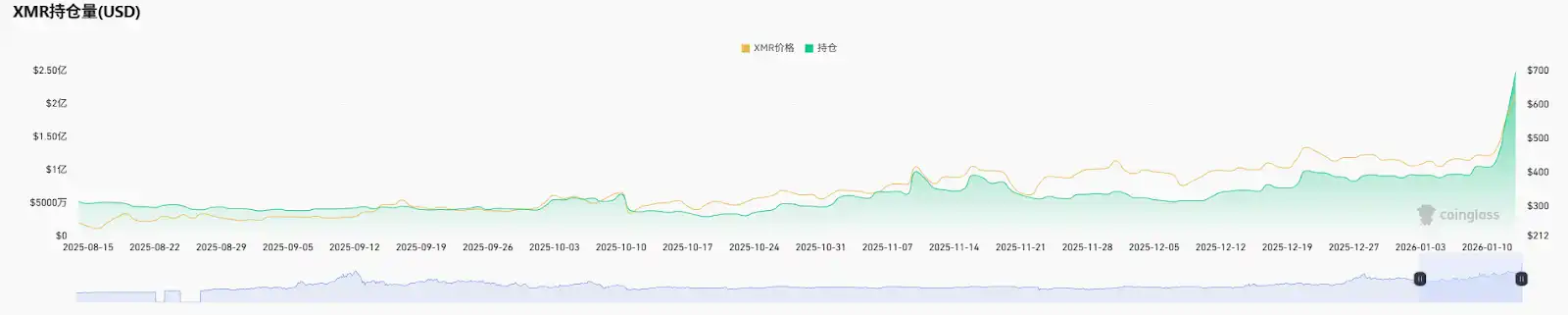
Evidently, mainstream trading platforms are not the core venue for pricing XMR at the moment.
Supply Side Undercurrent, Miner Shuffling, and Early Deployment
Since the "surface-level" funding is unremarkable, we need to turn to the "dark side" of the on-chain world. XMR, as the most privacy-centric network with minimal information leakage, yet with fluctuating mining difficulty and rewards, allows us to glimpse into capital deployment on the supply side.
Mining historical difficulty typically represents capital's enthusiasm for participating in the network ecosystem. Data shows that XMR's mining difficulty started to rise rapidly at the end of 2024 and remained in a rapid growth state throughout the first half of 2025. Although there were fluctuations from September to November, a new round of difficulty escalation has recently begun.
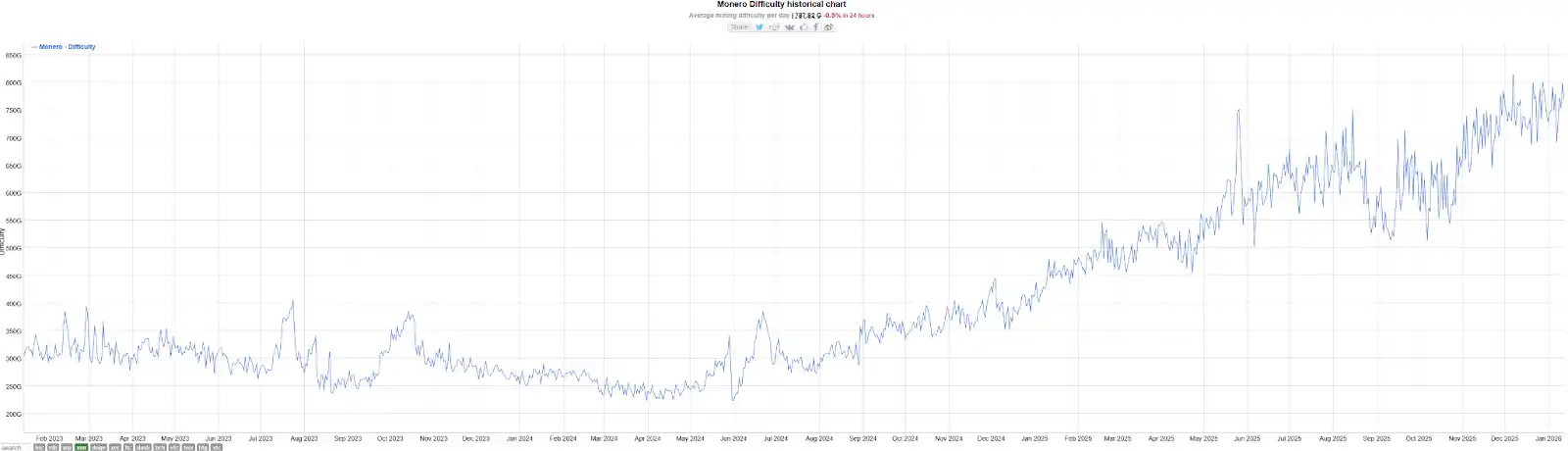
Here we have to mention an episode: In September, the Qubic project team claimed to control over 51% of XMR's total network hashrate and conducted a "demonstration attack," causing an 18-block chain reorganization on the XMR network. This event sounded the alarm for the community, and subsequently, a large number of miners migrated their hashrate to the established mining pool SupportXMR. This turmoil was the main reason for the dramatic fluctuations in mining difficulty at the end of 2025, but it also indirectly confirmed the vitality and resilience of the hashrate market.
More noteworthy is the linkage between mining rewards and difficulty.
Prior to April 2025, Monero network's mining rewards experienced a significant decline. Looking at the difficulty chart at that time, there was a sharp increase in hashrate while the coin price remained volatile. This deviation led to diluted rewards, possibly forcing some high-cost small miners out of the market. Data shows that the mining difficulty briefly dropped in April, confirming this speculation.
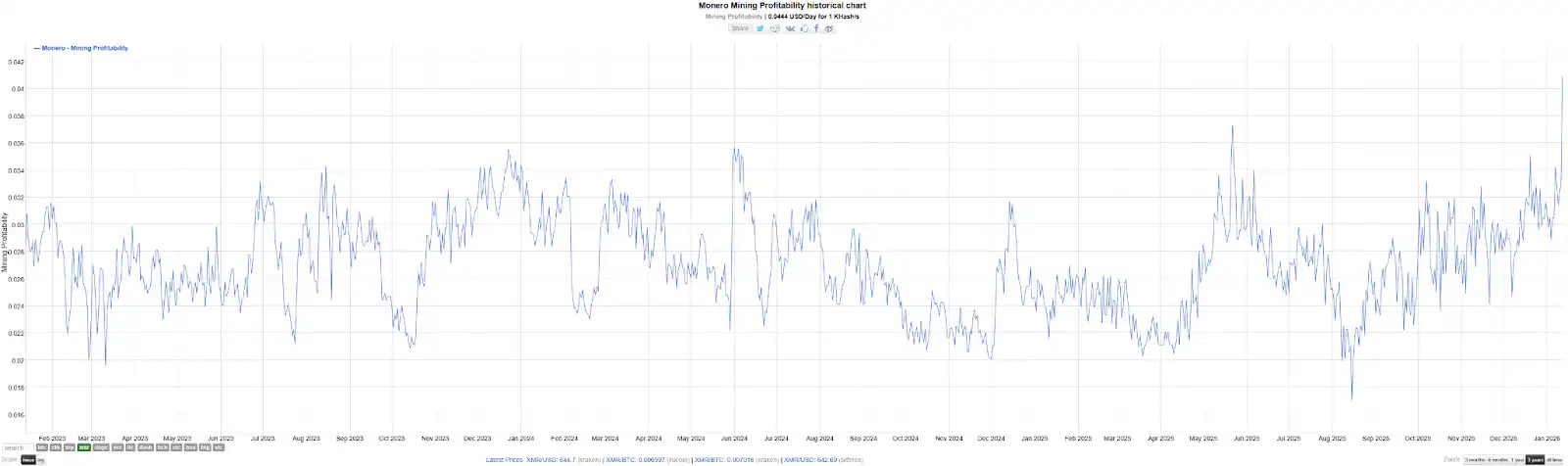
This was a typical case of "miner surrender" and "chip exchange." Subsequently, with a significant price surge, mining rewards and difficulty once again synchronously increased. From the data changes in this phase, it can be seen that as early as the beginning of 2025, some large mining companies or capital with strong risk resistance may have already started early deployment in Monero token mining despite the low returns.
Demand Side Validation, Premium for Privacy Payments
If miners represent the confidence on the supply side, then the average transaction fee most truthfully reflects the demand on the user side.
From the chart, Monero's average transaction fee remained relatively stable at below $0.1 until the first half of 2025. However, an upward trend began to emerge in June; by December 11, the highest average fee reached above $0.3, more than triple the amount from six months ago.
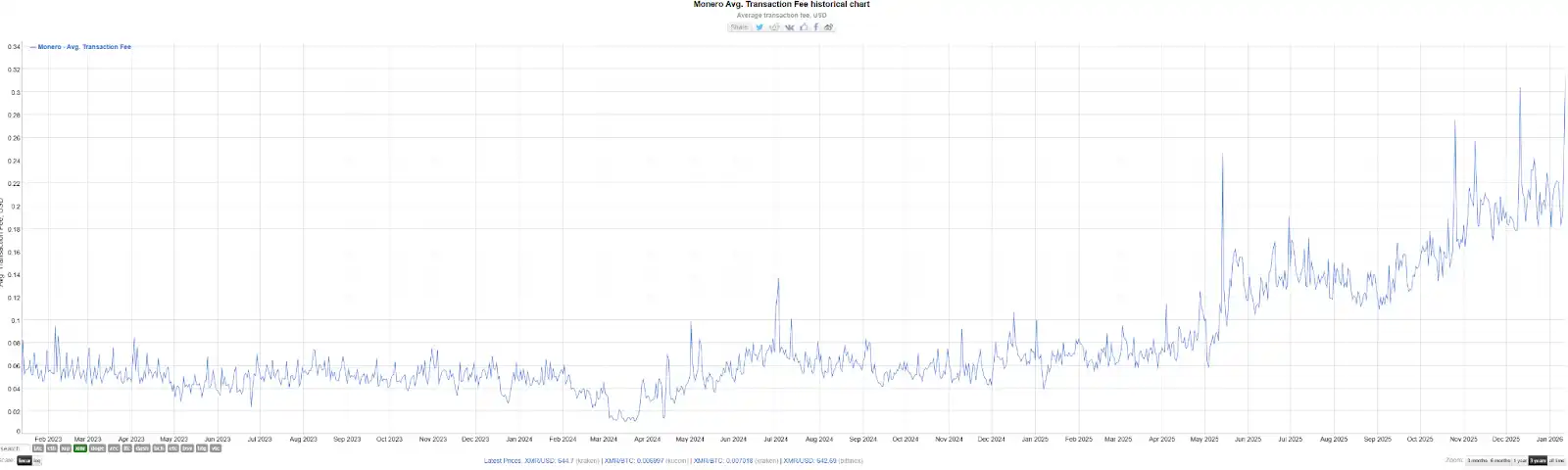
Due to Monero's dynamic block size mechanism, the surge in fees means that a large number of users are attempting to rapidly send transactions and are willing to pay high fees to compensate miners for the block size expansion cost. This indirectly proves that starting from the second half of 2025, the real transaction demand on the Monero chain began to increase significantly.
However, we have also discovered an interesting pattern: The surge in on-chain fees often occurs in sync with price surges.
For example, on April 28th, XMR suddenly rose by 14%, with the average transaction fee spiking to $0.125 on that day; whereas during the subsequent slow price climb period, the fees plummeted back to a low (bottoming at $0.058 on May 4th). This indicates that while market fluctuations can drive on-chain demand in the short term, when the volatility subsides, on-chain demand also returns to normal. Although sometimes the two are not always in sync (such as the fee increase on May 14th without a price movement), overall, over this year and a half period, price increases have temporarily driven on-chain demand, and the real on-chain demand growth has in turn sparked market optimism for XMR, with the two acting as cause and effect.
The Dual Nature of the Truth
From the above data, the surge in XMR may have a dual-natured truth.
The so-called "white" side is a "anti-fragile" rebound of privacy demand under high regulatory pressure.
The reverse thrust of regulation is becoming increasingly apparent. The ban by Dubai VARA not only failed to crush XMR but instead made market participants realize that regulatory agencies can ban trading platforms, but cannot ban the protocol itself. When major exchanges exited the XMR trading scene, relying on market makers and derivative pricing logic was rewritten, XMR returned to a pattern controlled by real users or some heavyweight players. After breaking away from the exchange system, privacy coins adopted an independent rhythm completely different from the mainstream market.
The "black" side is a capital game of information asymmetry.
Behind this opacity, there may be a "whale" lurking beneath the surface. The "not-so-impressive" transaction data (even on January 13, at an all-time high, the total contract holdings were only $240 million, with liquidation only a little over $1 million) indicates that mainstream institutions hardly predicted and participated in this rally in advance, only following suit.

This information asymmetry held by a few individuals leads to extreme price volatility. Particularly when the market starts to pay attention to this surge, it often indicates a short-term overheating of sentiment. Taking the example of the privacy coin ZEC in November, it experienced a retracement of over 50% after a surge. Ultimately, in the privacy coin market, there is a significant amount of "information asymmetry," putting retail investors at an absolute disadvantage.
In the midst of a privacy coin's violent volatility, on-chain data may be our only trusted guide. But in the opaqueness of the deep sea, free premium always comes with unknown risks.
You may also like

High ETH BTC Price Ratio: What It Means for Traders in 2026
Explore why the eth btc price ratio just hit a 10-week high in April 2026. We analyze the massive ETH ETP inflows and what this historic pivot means for your trading strategy this year. Is Ethereum finally ready to outpace Bitcoin?

What Is the New York Lawsuit Against Coinbase? Is Your Crypto Safe After the April 2026 Case
Wondering why New York sued Coinbase and Gemini in April 2026? Here's what the lawsuit means, whether your crypto funds are safe right now, and what could change for crypto users next.

Finally, Polymarket is teaming up with Kalshi to take a bite out of this cake
ENI officially announces the completion of its strategic brand upgrade: advancing from a foundational protocol to a global institutional-level financial new infrastructure

The person who brings Web3 closest to AI

MYX Case Analysis: The Complete Harvesting Tactics Behind the Fake Surge of Cryptocurrency Tokens

Gate founder Dr. Han: The crypto winter drives structural reshaping, and everything on-chain will become a new paradigm in finance

Is XRP a Good Investment in 2026? Why Is It Stuck at $1.45
XRP is up 6.7% this week, but exchange reserves remain high. Is a volatility spike imminent? We analyze price trend, ETF inflows, whale activity, and regulatory catalysts to answer: will XRP go up, why is XRP dropping, and is XRP a good investment right now?

FC Barcelona vs Celta Vigo: Can Anyone Stop Barcelona at Home?
FC Barcelona vs Celta Vigo lineups, standings, and stats for April 22, 2026. FC Barcelona need a win to stay on track for the La Liga title. Full preview inside.

Carl Moon & WEEX Head to Mugello: The Crypto Trader's Ferrari Challenge
Forget the sidelines. WEEX is hitting the 300km/h mark at Mugello this weekend. Witness Carl Moon’s transformation from a supermarket cashier to a Ferrari racer, and discover why the world’s fastest trading floor belongs on the world’s most technical track at the official Ferrari Challenge.

How to Become a Pro Crypto Trader: WEEX Interview with Ferrari Racer Carl Moon
Ferrari racer Carl Moon on mastering crypto trading: 80/20 rule, AI tools, Bitcoin at $95K, and risk lessons from the track.

Morning Report | Amazon increases investment in Anthropic up to $25 billion; SEC plans to introduce an "innovation exemption" mechanism to support compliant on-chain trading of tokenized securities

Jeff Hoffman, founder of Booking.com: How Web3 and AI are reshaping the trillion-dollar social travel market

Top 12 Cryptocurrencies to Invest in April 2026
Key Takeaways: Bitcoin remains the dominant player with a $1.42 trillion market cap. Hyperliquid’s HYPE token gains traction,…
18 Best Crypto & Bitcoin Casinos in March 2026
Key Takeaways: Cryptocurrencies offer faster, cheaper, and more private payment options in online casinos. Top crypto casinos include…

Full Post-Mortem of the KelpDAO Incident: Why Did Aave, Which Was Not Compromised, End Up in Crisis Situation?
Key Takeaways: The KelpDAO incident exposed vulnerabilities in collateral pricing and cross-chain bridge operations, affecting Aave’s liquidity. rsETH…

Is MicroStrategy’s STRC Bitcoin’s Savior or Destroyer?
Key Takeaways: MicroStrategy’s STRC offers an annualized yield of 11.5%, driving significant Bitcoin buying pressure. Michael Saylor’s financial…

Ceasefire Expiration and Market Response: Bitcoin Defies Market Trends
Key Takeaways: The current ceasefire agreement is anticipated to expire on Wednesday in Washington, with low likelihood of…
High ETH BTC Price Ratio: What It Means for Traders in 2026
Explore why the eth btc price ratio just hit a 10-week high in April 2026. We analyze the massive ETH ETP inflows and what this historic pivot means for your trading strategy this year. Is Ethereum finally ready to outpace Bitcoin?
What Is the New York Lawsuit Against Coinbase? Is Your Crypto Safe After the April 2026 Case
Wondering why New York sued Coinbase and Gemini in April 2026? Here's what the lawsuit means, whether your crypto funds are safe right now, and what could change for crypto users next.


 App
App