
NIO Stock: Price, Forecast and 2026 Outlook

NIO stock is back on investors’ watchlists after a stronger operating finish to 2025 and a sharp improvement in early 2026 deliveries. The debate is no longer only about whether NIO can sell more electric vehicles. The more important question is whether delivery growth, margin improvement, and cost control can turn the company into a sustainably profitable EV business.
As of early May 2026, NIO Inc. trades on the NYSE under the ticker NIO, with additional listings in Hong Kong and Singapore. The stock remains volatile, but recent results have given bulls more to work with than they had during NIO’s weaker loss-making periods.

For traders who follow high-volatility assets across markets, NIO stock also sits in the same risk-on conversation as other speculative growth assets. Platforms such as WEEX give traders access to crypto spot and futures markets, which can help them monitor broader sentiment beyond traditional equities.
NIO Stock Price Today
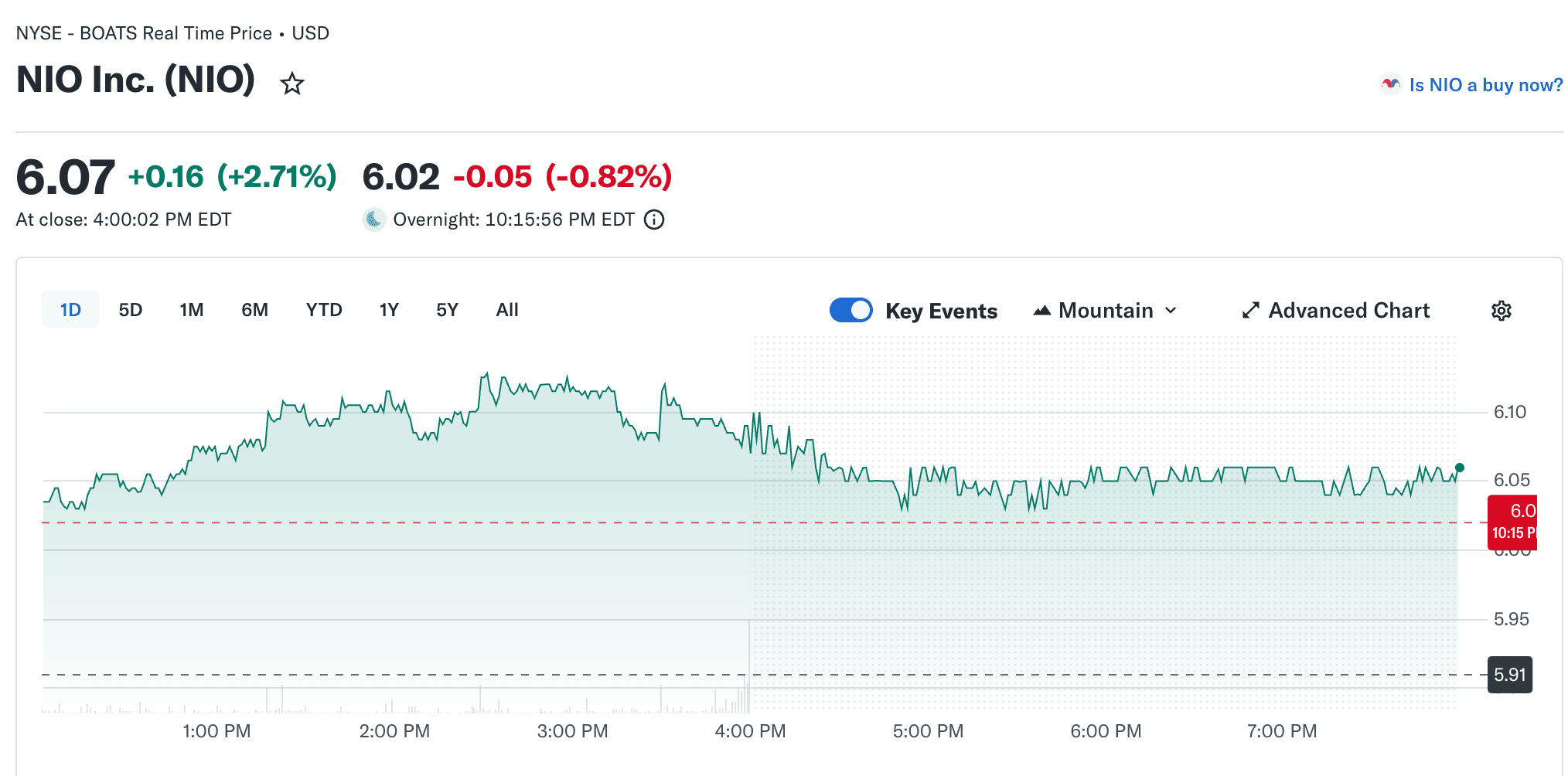
NIO stock recently traded near the low-$6 range in the U.S. market. Price changes can move quickly around EV delivery updates, earnings releases, analyst target revisions, and China macro headlines, so investors should always check a live quote before making any decision.
| Item | Latest Context |
|---|---|
| Company | NIO Inc. |
| U.S. ticker | NIO |
| Main listing | NYSE |
| Sector | Electric vehicles |
| Core market | China, with international expansion |
| Recent stock area | Around the low-$6 range in early May 2026 |
| Main catalysts | Deliveries, margins, profitability, China EV competition |
NIO stock tends to trade like a high-beta EV name. That means strong delivery numbers can trigger fast upside, while margin pressure, dilution concerns, or weak guidance can quickly reverse sentiment.
What Is NIO?
NIO is a Chinese smart electric vehicle company known for premium EVs, battery swapping, and a growing multi-brand strategy. Its portfolio includes the main NIO brand, ONVO for family-oriented vehicles, and FIREFLY for smaller high-end electric cars.
The company’s investment story has changed over time. Earlier, NIO stock was mostly valued on future EV adoption and brand potential. In 2026, investors are watching harder operating metrics: vehicle deliveries, gross margin, cash balance, and whether quarterly profitability can become repeatable.
That shift matters. EV companies can post impressive revenue growth while still destroying shareholder value if each vehicle is sold with weak margins, heavy marketing costs, or recurring capital raises.
Latest NIO Earnings and Delivery Data
NIO’s fourth quarter of 2025 was a key turning point. The company reported 124,807 vehicle deliveries in Q4 2025, up 71.7% year over year. Full-year 2025 deliveries reached 326,028 vehicles.
Financially, Q4 2025 showed meaningful improvement:
| Metric | Q4 2025 Result |
|---|---|
| Vehicle deliveries | 124,807 |
| Total revenue | RMB 34.65 billion |
| Vehicle margin | 18.1% |
| Gross margin | 17.5% |
| Net profit | RMB 282.7 million |
| Cash and equivalents, restricted cash, short-term investments and long-term time deposits | RMB 45.9 billion |
The strongest point is not simply that NIO delivered more cars. It is that higher deliveries came with better vehicle margin and a quarterly net profit. That combination is what investors usually need to see before re-rating a growth stock.
Still, the full-year picture remains mixed. NIO reported a net loss for 2025 overall, which means one strong quarter does not fully remove profitability risk.
NIO Stock Forecast and Analyst Price Targets
Recent analyst data shows a moderate bullish tilt toward NIO stock, but not a clean consensus that the stock is deeply undervalued. StockAnalysis recently showed an average analyst price target around $6.73, with a “Buy” consensus from covered analysts. Other forecast platforms also tend to frame NIO as a recovery candidate rather than a low-risk compounder.
| Scenario | What Would Need to Happen |
|---|---|
| Bull case | Deliveries keep rising, vehicle margin stays healthy, and quarterly profitability becomes more consistent |
| Base case | NIO grows revenue but remains volatile as investors wait for proof of durable earnings |
| Bear case | China EV price competition compresses margins, cash burn returns, or shareholder dilution increases |
A reasonable NIO stock forecast depends less on abstract EV optimism and more on execution. If NIO can keep scaling ONVO and FIREFLY without damaging margins, the stock has a stronger recovery argument. If growth requires discounting, incentives, or more financing, the upside case weakens.
Bull Case for NIO Stock
The bull case starts with delivery momentum. NIO’s Q1 2026 deliveries reached 83,465 vehicles, up 98.3% year over year, according to company delivery updates. That kind of growth can matter if it leads to operating leverage.
The second bullish factor is margin recovery. Vehicle margin at 18.1% in Q4 2025 was a major improvement from earlier periods. In a competitive EV market, margin quality is often more important than headline unit growth.
The third factor is brand segmentation. NIO’s use of multiple brands could help it address different buyer groups without forcing one premium brand to serve every price point. If managed well, that can expand volume while protecting the core brand.
Bear Case and Key Risks
The bear case is still serious. NIO operates in one of the most competitive EV markets in the world. Chinese EV makers face intense pricing pressure, rapid model cycles, and constant investor comparison with Tesla, BYD, XPeng, Li Auto, and other manufacturers.
The practical risk is margin slippage. Many investors lose money in EV stocks by focusing only on delivery growth. A company can sell more vehicles and still disappoint shareholders if discounts, warranty costs, financing costs, or operating expenses absorb the benefit.
NIO stock also carries dilution and balance sheet risk. Even with a sizable cash position, a company that has not yet proven full-year profitability may need future financing if market conditions weaken or expansion costs rise.
For active traders, volatility is another issue. NIO can move sharply around monthly delivery reports, earnings calls, analyst notes, and China policy headlines. Position sizing matters more than narrative confidence.
Traders who compare equity volatility with crypto-market volatility can also review WEEX Futures for broader derivatives market access. Futures products involve leverage and can amplify losses, so they are better treated as risk tools for experienced users rather than shortcuts to higher returns.
Is NIO Stock a Buy, Hold, or Sell?
NIO stock looks like a recovery story with improving evidence, not a settled winner. The latest delivery and margin data support a more constructive view than in weaker periods, but the company still needs to prove that Q4 2025 was not a one-off profitability spike.
For long-term investors, the key things to watch are vehicle margin, operating cash flow, full-year net loss reduction, and whether ONVO and FIREFLY expand volume without dragging down pricing power.
For shorter-term traders, the stock is likely to remain catalyst-driven. Monthly deliveries, earnings guidance, and China EV sentiment can matter more than traditional valuation models over short windows.
Conclusion
NIO stock has become more interesting because the company is showing real operating improvement: stronger deliveries, better margins, and a profitable Q4 2025. But the stock is still not a simple EV growth story. The investment case depends on whether NIO can repeat that performance across multiple quarters while navigating price competition and capital needs.
The better reading is balanced: NIO stock has recovery potential, but the proof point is sustainable profitability, not just higher deliveries. Investors and traders should track the next delivery updates, margin trend, and cash flow data before assuming the turnaround is complete.
For market participants who also trade digital assets, WEEX offers access to crypto spot and futures markets, giving traders another venue to follow risk appetite across high-volatility assets.
FAQ
What is NIO stock?
NIO stock represents shares of NIO Inc., a Chinese smart electric vehicle company listed on the NYSE under the ticker NIO.
Why is NIO stock moving?
NIO stock often moves because of monthly delivery updates, quarterly earnings, analyst target changes, China EV competition, and broader risk sentiment in growth stocks.
Is NIO profitable?
NIO reported a net profit in Q4 2025, but the company still recorded a net loss for the full year 2025. Investors should watch whether quarterly profitability becomes consistent.
What is the NIO stock forecast for 2026?
Analyst forecasts are mixed but lean moderately positive, with recent average price targets around the mid-$6 range. The outlook depends heavily on delivery growth, margin stability, and cost control.
What are the biggest risks for NIO stock?
The main risks are EV price competition, margin compression, shareholder dilution, inconsistent profitability, China macro risk, and high share-price volatility.