
Cryptocurrency Market Capitalization – What Does It Mean and How to Interpret It? (2026)

What is cryptocurrency market capitalization and how should it be interpreted? (2026)
Cryptocurrency market capitalization (market cap) is the total value of all coins or tokens of a given cryptocurrency currently in circulation. It is calculated by multiplying the current price of the cryptocurrency by the number of tokens available on the market. Market capitalization helps investors assess the size of a project, its stability, and potential investment risks.
By analyzing cryptocurrency market capitalization, one can better understand why Bitcoin remains the largest cryptocurrency in the world, how altcoins differ from stablecoins, and how investors evaluate the potential growth of blockchain projects.
In this guide, we explain what cryptocurrency market capitalization is, how to interpret it, and how to use market cap when analyzing the crypto market.

What is cryptocurrency market capitalization?
Cryptocurrency market capitalization (market cap) is the total value of all coins and tokens in circulation. It is one of the most important indicators used to analyze the cryptocurrency market.
Cryptocurrency market capitalization helps investors assess:
- project size,
- level of investor interest,
- potential stability,
- market volatility,
- possible investment risk.
The larger the market capitalization of a cryptocurrency, the more stable the project is generally considered to be and the less susceptible it is to sudden price fluctuations.
Global cryptocurrency market capitalization changes every day as the prices of Bitcoin, Ethereum, and altcoins rise or fall.
How is market capitalization calculated?
Market capitalization is calculated by multiplying the current price of a cryptocurrency by the number of coins or tokens in circulation.
Formula:
Market capitalization = cryptocurrency price × number of coins or tokens in circulation
For example:
- if the BTC price is 100,000 USD,
- and there are 19 million coins in circulation,
then the Bitcoin market capitalization is approximately 1.9 trillion USD.
It is worth remembering that market cap does not show the amount invested in a project, but rather its current market valuation.
How does market capitalization differ from the price of a cryptocurrency?
Many beginner investors believe that a token costing 0.01 USD is "cheaper" than Bitcoin costing tens of thousands of dollars. In practice, the price of a cryptocurrency alone says little about the value of the project.
Of great importance are:
- token supply,
- number of coins in circulation,
- total market capitalization,
- investor interest.
A project may have a very cheap token, but at the same time a huge number of coins and a high cryptocurrency market capitalization.
Therefore, when analyzing the market, it is worth looking not only at cryptocurrency prices but also at:
- market capitalization,
- trading volume,
- tokenomics,
- project assets,
- market volatility.
If you are just starting your journey with the cryptocurrency market, also read the guide "How to start investing in cryptocurrencies in 2026?".
Why is cryptocurrency market capitalization important?
How does market capitalization help assess investment risk?
Cryptocurrency market capitalization helps investors better manage investment risk. High-cap cryptocurrencies are usually more stable than small-cap projects.
Large projects have:
- higher liquidity,
- higher trading volume,
- greater trader interest,
- more stable cryptocurrency prices.
In turn, low-cap projects can generate very high profits, but at the same time are more susceptible to:
- price manipulation,
- sudden drops,
- low liquidity,
- high volatility.
Therefore, market capitalization is an important indicator that helps assess potential investment risk.
Large cap, mid cap, and small cap – what do they mean?
Cryptocurrencies are usually divided into three main groups:
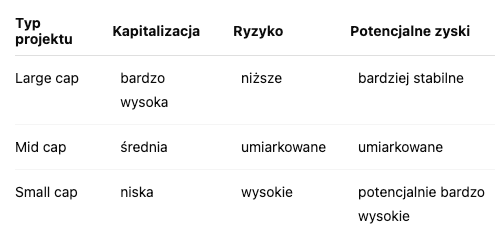
Large cap cryptocurrencies primarily include Bitcoin and Ethereum. These are the largest projects in the cryptocurrency market in terms of market capitalization. Large cap refers to cryptocurrencies with a very high market value, which are usually characterized by greater stability, high liquidity, and significant investor interest.
Mid caps are cryptocurrencies with medium market capitalization. Most often, these are developing altcoins that already have an established position but still have the potential for further growth. Mid cap projects often offer higher potential profit than Bitcoin, but at the same time involve higher risk and greater volatility.
Small caps are small cryptocurrency projects with low market capitalization. Cryptocurrencies of this type can grow dynamically during a bull run and generate very high profits, but they are also more susceptible to sudden price drops, low liquidity, and higher investment risk.
Does a larger market capitalization mean a safer investment?
Larger market capitalization usually means:
- greater investor interest,
- higher liquidity,
- greater stability,
- lower risk of sudden price movements.
However, this does not guarantee success. Even large cryptocurrency projects can lose value during a bear market or due to technological problems.
The cryptocurrency market remains very volatile, and every investment carries risk.
You can read more about market risk in the article: "What is liquidation in cryptocurrencies and how to avoid it?".
Bitcoin capitalization and BTC dominance
Why does Bitcoin have the largest market capitalization?
Bitcoin is the largest cryptocurrency in the world in terms of market capitalization and has dominated the cryptocurrency market for years. After Bitcoin, it is Ethereum that has the second-largest cryptocurrency market capitalization and plays a key role in the development of the blockchain, DeFi, and smart contract markets.
This is influenced by:
- BTC recognition,
- limited supply of 21 million coins,
- huge interest from institutional investors,
- high market liquidity,
- status as the first blockchain cryptocurrency.
Bitcoin's capitalization has a huge impact on the entire cryptocurrency market. When BTC rises or falls dynamically, it often also affects the prices of altcoins.
What is Bitcoin dominance?
BTC dominance (Bitcoin Dominance) shows what percentage of the total cryptocurrency market capitalization belongs to Bitcoin.
High BTC dominance usually means that investors are choosing more stable assets and limiting the risk associated with altcoins.
A decline in Bitcoin dominance often occurs during altseason, when capital flows into riskier projects with higher growth potential.
How to interpret the rise and fall of BTC dominance?
A rise in BTC dominance may mean:
- capital outflow from altcoins,
- greater investor caution,
- worsening market sentiment.
A decline in Bitcoin dominance often suggests:
- increased interest in altcoins,
- greater risk appetite,
- the beginning of an altseason.
Analyzing BTC dominance helps investors better interpret capital flow in the cryptocurrency market.
We discuss the topic of market cycles and altseason more broadly in the article: "Cryptocurrency market cycle: bull run, bull and bear markets – how does the Bitcoin cycle work?".
What is FDV and why does it matter?
Market capitalization vs. FDV
FDV (Fully Diluted Valuation) is an indicator showing what the capitalization of a cryptocurrency would be if all tokens had already been introduced into circulation.
In practice, FDV helps investors assess what the future value of a project might look like after the entire token supply is released.
In FDV analysis, two concepts are important:
- circulating supply — the number of tokens currently available on the market,
- total supply — the total token supply of the project.
Some projects have a small number of tokens in circulation but a very large future supply that may be released in the coming years. In such a situation, the current market capitalization may look attractive, even though the future diluted valuation of the project will be significantly higher.
Why can FDV be misleading?
A high FDV may indicate potential risk associated with future token supply inflation.
If a project regularly releases new tokens, it can lead to:
- increased supply,
- selling pressure,
- a drop in cryptocurrency price,
- dilution of token value.
Therefore, during investment analysis, it is worth paying attention not only to the current cryptocurrency market capitalization but also to the project's tokenomics and the token release schedule.
How to analyze new cryptocurrency projects?
When analyzing new projects, it is worth checking:
- token circulation,
- total project supply,
- trading volume,
- market liquidity,
- community activity,
- project tokenomics,
- future token release schedule.
Analyzing market capitalization charts and market statistics available on platforms such as CoinMarketCap or CoinGecko can also be helpful.
How to use market capitalization in cryptocurrency analysis?
How do investors analyze market capitalization?
Investors use market capitalization to:
- compare cryptocurrency projects,
- assess potential growth,
- analyze trends,
- assess risk levels.
Cryptocurrencies by market capitalization allow you to quickly check which projects dominate the market and how the investment situation changes over time.
During a bull run, investors often look for mid- and small-cap altcoins, hoping for higher potential profits.
Does market cap help predict future cryptocurrency prices?
Market capitalization is an important indicator, but it does not allow for accurate prediction of future cryptocurrency prices.
The market is also influenced by:
- investor sentiment,
- macroeconomic situation,
- blockchain technology adoption,
- trader actions,
- trading volume,
- global investment trends.
Therefore, market cap should be only one element of cryptocurrency market analysis.
How to observe the cryptocurrency market capitalization chart?
Investors often analyze the cryptocurrency market capitalization chart to track:
- global cryptocurrency market capitalization,
- cryptocurrency price changes,
- trading volume,
- BTC dominance,
- market statistics,
- price trends.
On platforms such as TradingView, CoinMarketCap or CoinGecko, you can observe market capitalization charts, cryptocurrency prices, and statistics for the entire market.
These platforms allow you to analyze:
- cryptocurrency prices and charts,
- cryptocurrency exchange rates,
- changes over the last 24 hours,
- trader activity,
- current market trend.
If you want to better analyze the market, also read the guide "How to read cryptocurrency charts? Candlestick analysis for beginner investors".
Most important things to remember
- Cryptocurrency market capitalization shows the total value of a project.
- Market capitalization is calculated based on price and the number of tokens in circulation.
- Bitcoin has the largest cryptocurrency market capitalization.
- Small caps can offer higher profits but involve higher risk.
- The price of a cryptocurrency alone does not tell you if a project is "cheap" or "expensive".
- FDV helps assess potential future token supply.
- The cryptocurrency market capitalization chart helps analyze trends and market sentiment.
Frequently asked questions about market capitalization
What is cryptocurrency market capitalization?
Cryptocurrency market capitalization is the total value of all coins or tokens in circulation.
How is a cryptocurrency's market cap calculated?
Market capitalization is calculated by multiplying the current price of a cryptocurrency by the number of tokens in circulation.
Does Bitcoin have the largest market capitalization?
Yes, Bitcoin has had the largest cryptocurrency market capitalization for years.
What do small cap and large cap cryptocurrencies mean?
Large cap refers to large cryptocurrencies with high market capitalization, such as Bitcoin or Ethereum. Projects of this type are usually more stable, have higher liquidity, and enjoy greater investor interest.
Small cap refers to smaller cryptocurrency projects with lower market capitalization. Small cap cryptocurrencies can offer greater growth potential, but at the same time involve higher risk and greater price volatility.
Does high capitalization mean a safe investment?
Not always, but larger capitalization usually involves greater liquidity and market stability.
What is FDV in cryptocurrencies?
FDV (Fully Diluted Valuation) shows what the capitalization of a cryptocurrency would be if all tokens had already been introduced into circulation. This indicator helps investors assess potential future token supply and the risk associated with project inflation.
Disclaimer