What is NEAR (NEAR Protocol)? AI Blockchain Mechanics, 2026 Trends, and How to Trade on WEEX

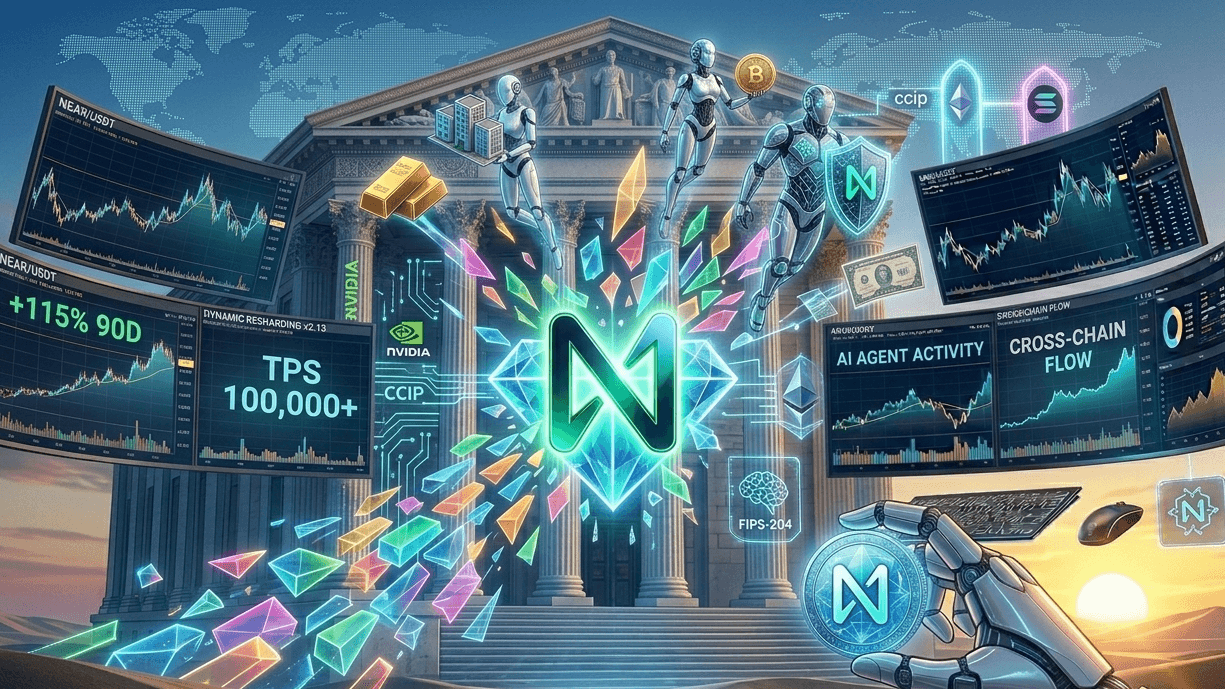
On May 23, 2026, NEAR surged 34% in 24 hours to reach $2.32. It recorded a 50% increase over the week and a 115% rise over the past 90 days, with 24-hour trading volume briefly exceeding $1 billion.
NEAR is an L1 protocol that brands itself as a "blockchain for AI," designed as an execution layer where AI agents can hold assets, make decisions, and execute trades. With Dynamic Resharding and the integration of post-quantum cryptography scheduled for June 2026, along with its participation in Nvidia Inception, the project is well-positioned for the biggest theme of 2026: the intersection of AI and blockchain.
What is NEAR (NEAR Protocol)?
Founded: 2018 (Co-founded by Illia Polosukhin and Alexander Skidanov)
Consensus: Proof of Stake (PoS) and Nightshade sharding
Processing Speed: Up to 100,000 TPS (post-Dynamic Resharding); transaction finality in approximately 1–2 seconds
Fees: Approximately $0.0001 per transaction (extremely low)
Current Price: Approximately $2.2–$2.3 (as of May 2026); ATH: $20.44 (January 2022)
Market Cap: Approximately $2.7–$2.8 billion; ranked 35th–40th on CoinGecko
NEAR Features: A Blockchain for AI Agents
Chain Abstraction
NEAR's greatest differentiator is "chain abstraction." It is designed so that users and AI agents can interact seamlessly across multiple blockchains without needing to be aware of which chain they are on. Complex operations, such as using Ethereum DeFi, purchasing Solana NFTs, and settling payments on NEAR, can be completed using a single account.
Execution Layer for AI Agents
NEAR provides the infrastructure for AI agents to hold assets on-chain and autonomously make decisions and execute trades. NEAR AI participates in Nvidia's Inception program (startup support) and is gaining attention in the field of "verifiable privacy-preserving AI computation." On May 20, 2026, it completed a rollout to automatically remove passwords and personal information from prompts sent to AI models (such as Claude, ChatGPT, and Gemini), strengthening its integration into enterprise AI workflows.
On May 9, 2026, NEAR AI simultaneously launched "IronClaw" and a "Confidential GPU Marketplace." IronClaw is an open-source AI agent runtime written in Rust that operates within a TEE (Trusted Execution Environment), allowing AI agents to perform browsing, trading, and automation while maintaining confidentiality. The Confidential GPU Marketplace is a decentralized computing network protected by TEE, designed so that third parties, including GPU owners, cannot view the processing content. This clearly defines its competitive position in capturing "enterprise GPU demand" from centralized clouds like AWS and Google Cloud.
| Comparison Item | Typical L1 | NEAR |
| AI Agent Support | Limited | Native support; asset holding and autonomous trading possible |
| Cross-chain Operation | Bridge required | Operate from a single account via chain abstraction |
| Scalability | Fixed shard count | Auto-scaling based on demand via Dynamic Resharding (June 2026) |
| Quantum Resistance | Not supported (most) | FIPS-204 post-quantum cryptography integrated in May 2026 |
Key Trends in 2026
Dynamic Resharding (Scheduled for June 2026)
NEAR is scheduled to transition in June 2026 from scaling via a fixed number of shards to "Dynamic Resharding," which allows for the automatic addition of shards based on demand. The network can autonomously expand capacity without human intervention, a design capable of handling surges in AI agents and on-chain activity. The theoretical maximum processing capacity reaches 100,000 TPS, achieving speeds comparable to Visa.
Integration of Post-Quantum Cryptography (May 2026)
The protocol has integrated FIPS-204 (ML-DSA), a cryptographic standard resistant to quantum computers. This enables secure key rotation in a single transaction, protecting user assets from future attacks by quantum computers. Like ZEC, quantum resistance serves as a selling point for ESG- and security-focused institutional investors.
Direct Reasons for the Short-Term Surge
The direct trigger for the 34% surge on May 23 was a short squeeze. In the NEAR futures market, short positions were forcibly liquidated in large numbers during a breakout at a specific price range, and the resulting forced buybacks accelerated the price increase. Combined with integration with CoW Swap and a market-wide rotation into AI tokens, multiple factors functioned simultaneously. While the price has stabilized around $2.2–$2.3, now that the liquidation of short positions has run its course, the market is entering a phase where it will be tested by real demand leading up to Dynamic Resharding (end of June).
Bitwise NEAR Staking ETP and Institutional Inflow
Bitwise offers a NEAR staking ETP (Exchange Traded Product), and Grayscale has also shown interest. The availability of institutional products that allow for staking rewards while holding NEAR supports capital inflows beyond retail investors.
Risks and Considerations
Significant Drop from ATH: The current price of $2.2–$2.3 is approximately 89% lower than its ATH ($20.44). While the "AI x Blockchain" theme is powerful, price recovery requires continuous institutional capital inflow and the practical application of the ecosystem.
Short-term Leverage-Driven Rise: The May surge was partly driven by mechanical movements from a short squeeze. Surges caused by short-term deleveraging without improvements in fundamentals are prone to sharp reversals.
High Competition: There are many projects competing for the "AI x Blockchain" position, such as ICP, FET, and TAO. While NEAR AI's differentiation (Nvidia collaboration, privacy-preserving AI computation) is clear, continuous monitoring is necessary to see if its competitive advantage will be maintained.
Summary
NEAR is an L1 blockchain designed as an "execution layer for AI agents." It is simultaneously deploying three axes in 2026: AI, security, and scalability, through chain abstraction, Dynamic Resharding, post-quantum cryptography, and participation in Nvidia Inception. While the May 23 surge was partly due to a short squeeze, the project holds high medium- to long-term interest as institutional capital flows in and the roadmap is executed. On WEEX, you can trade both NEAR/USDT spot and NEARUSDT futures.
FAQ
Q. What is the difference between NEAR and Solana?
Both are high-speed, low-cost L1s, but their design philosophies differ. Solana achieves single-chain throughput via PoH (Proof of History). NEAR features sharding and chain abstraction to enable seamless operations across multiple chains, allowing AI agents to operate autonomously across multiple chains.
Q. What is Dynamic Resharding?
It is a mechanism that automatically expands a blockchain's processing capacity according to demand. Conventional sharding had a fixed number of shards, leading to processing bottlenecks during sudden traffic increases. With Dynamic Resharding, the network autonomously adds or removes shards, allowing it to flexibly respond to surges in AI agents and DeFi activity. It is scheduled for implementation in June 2026.
Q. What do I need to trade NEAR on WEEX?
With a WEEX account and USDT, you can trade both NEAR/USDT spot and futures. You might consider trading strategies aligned with roadmap milestones, such as the launch of Dynamic Resharding (scheduled for June 2026). If using futures, be sure to set TP/SL (Take Profit/Stop Loss).
Disclaimer
WEEX and its affiliates provide digital asset exchange services, including derivatives and margin trading, only to eligible users in legally permitted regions. This content is for general information purposes only and does not constitute investment advice. Please consult with a professional before trading. Cryptocurrency trading carries high risk, and you may lose all of your invested funds. By using WEEX services, you agree to all associated risks, Terms of Service, and Risk Disclosure. Please exercise your own judgment and invest only what you can afford to lose.