
Cisco Stock After Q4 FY26: Record AI Orders, Thinner Margins

 Prefer us on Google

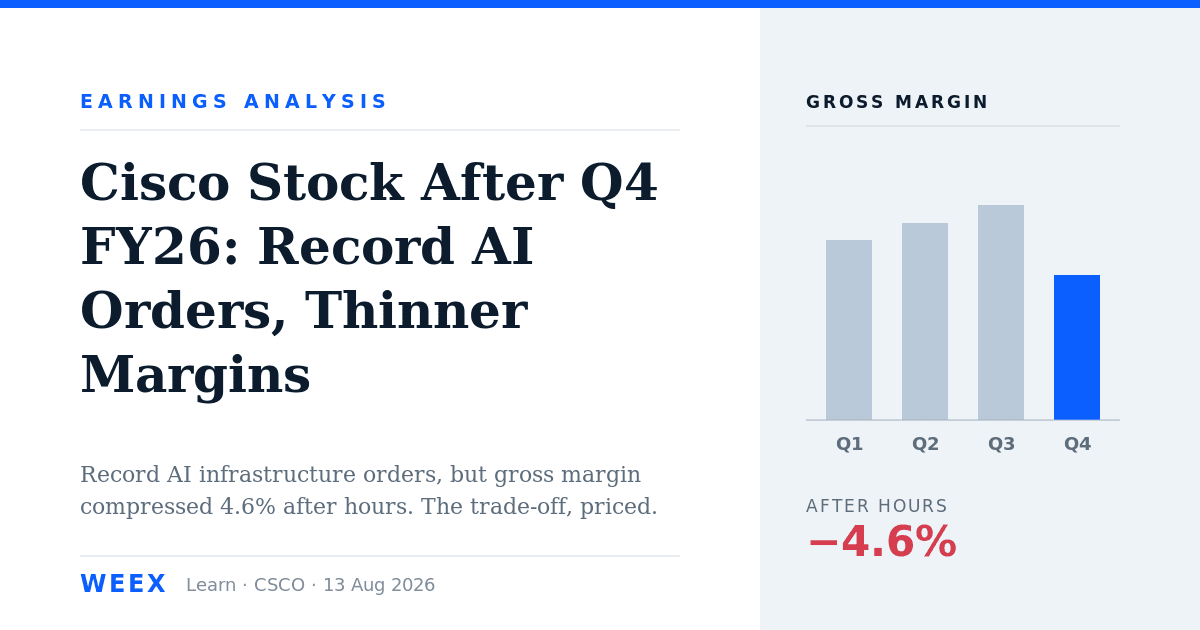
Cisco stock closed at $123.88 on August 12, 2026, then dropped roughly 4.6% in after-hours trade to about $118.18 — on the same day the company posted the best quarter in its history. Revenue of $17.3 billion was up 18% year over year, non-GAAP EPS of $1.22 was up 23%, and both beat guidance. The market sold it anyway.
That gap between the print and the reaction is the story worth understanding, and it is the thing most Cisco stock quote pages will not explain. Below: what the Q4 numbers actually showed, why gross margin guidance overrode a record top line, where the analyst consensus sits after the report, and — the part almost nobody covers — how the tokenized versions of Cisco stock now trading on crypto venues behave differently from CSCO on the Nasdaq.
Cisco stock price today and what the Q4 print showed
Cisco's fiscal fourth quarter, reported August 12, 2026, was a genuine beat on both lines. Fiscal 2026 revenue landed at $63.3 billion, up 12% from $56.7 billion in fiscal 2025.
The number that mattered most was orders, not revenue. Hyperscaler AI infrastructure orders reached $9.3 billion for fiscal 2026 — roughly 4.5x the prior year — with $4 billion of that booked in Q4 alone. Total Q4 product orders rose 35%. For a company that spent a decade being described as ex-growth telecom plumbing, that is a structural repricing of the business.
| Cisco Q4 / FY2026 metric | Result | Change |
|---|---|---|
| Q4 revenue | $17.3B | +18% YoY |
| Q4 non-GAAP EPS | $1.22 | +23% YoY |
| FY26 revenue | $63.3B | +12% YoY |
| FY26 hyperscaler AI orders | $9.3B | ~4.5x YoY |
| Q4 product orders | — | +35% YoY |
| Q1 FY27 revenue guide | $18.0–18.2B | above consensus |
| FY27 revenue guide | $72.2–73.4B | ~+15% |
| FY27 AI infrastructure revenue guide | $7.5B | — |
Source: Cisco Q4 FY2026 earnings release, August 12, 2026.
Cisco stock traded between $115.53 and $128.99 during the session — an unusually wide 11% band that tells you how little consensus there was on how to price the result. Over the past year the range is $65.75 to $130.37, so the shares nearly doubled into the print.
Why Cisco stock fell after a record quarter
Management guided Q1 FY27 non-GAAP gross margin to 65–66%, and attributed the pressure to a heavier hardware mix. That is the whole explanation for the after-hours drop.
The logic is straightforward once you see what AI orders are made of. Selling switches and optics into hyperscaler data centers is a lower-margin business than selling security software and networking subscriptions. So the faster the AI segment grows, the more it dilutes the blended margin — growth and profitability are pulling in opposite directions inside the same backlog.
The more useful reading is that this is a mix problem, not a demand problem. A company converting a $9.3 billion order book into $7.5 billion of FY27 AI infrastructure revenue is not struggling to sell. But investors who had bid Cisco stock up as an AI beneficiary were paying for margin expansion alongside growth, and only got one of the two. When a stock has run from $65.75 to nearly $130 in twelve months, the market does not need a bad quarter to take profits — it only needs an incomplete one.
Is Cisco stock a good buy at ~27x forward earnings?
Wall Street stayed constructive. Across 26 analysts polled by S&P Global, the consensus rating is Buy with an average price target of $132.59 — roughly 7–8% above the pre-earnings level. The dispersion is what to look at: the low target is $115 and the high is $150.
That spread is not analysts disagreeing about Cisco's products. It is a disagreement about the multiple. Cisco stock trades near 27x forward earnings against a historical average well below that, which means the AI order book is already substantially in the price.
| Scenario | What has to happen | Rough CSCO path |
|---|---|---|
| Bull | AI revenue converts at/above the $7.5B FY27 guide and gross margin holds ≥66% | Toward the $150 high target |
| Base | Guidance is met, margin stays 65–66%, multiple flat | $130–135, near consensus |
| Bear | Hardware mix pushes margin below 65%, or hyperscaler capex slows | Back toward the $115 low target |
Scenario framework built from Cisco's stated FY27 guidance and the published analyst target range as of August 2026. Not a forecast.
There is also a floor argument that gets overlooked in AI-narrative coverage. Cisco pays an annual dividend of $1.68 per share — about a 1.4% yield at current levels — and has raised it for 14 consecutive years, while retiring roughly 0.66% of its 3.94 billion shares over the past year. Combined shareholder yield sits in the low-4% range. That is not why anyone buys Cisco stock in 2026, but it is why the downside has historically been shallower than in pure-play AI names.
CSCO, CSCOon and CSCOX: three ways to hold Cisco exposure
Here is where the standard Cisco stock coverage stops and something more interesting begins. Since 2025, Cisco has existed as a tradable asset in three distinct forms, and they are not interchangeable.
| Instrument | CSCO (Nasdaq) | CSCOon (Ondo) | CSCOX (xStocks) |
|---|---|---|---|
| What it is | The actual common share | Tokenized share, 1:1 custodied | Tokenized tracker certificate, 1:1 custodied |
| Chain | — | Ethereum / multi-chain | Solana SPL + ERC-20 |
| On-chain market cap | $488.26B (equity) | $3.02M | ~$0.40M |
| Trading hours | US market hours | ~24/7 on CEX/DEX | ~24/7 on CEX/DEX |
| Shareholder rights | Full (dividend, voting) | No direct voting | No direct voting |
| Where it trades | Nasdaq | WEEX, Gate, Bitget, MEXC, BingX | Kraken, Bybit, Gate, MEXC |
CSCOon figures from the WEEX CSCOon token page, last updated 08/13/2026 01:45 UTC. Equity market cap as of early August 2026.
The scale gap is the number to internalize. CSCOon's entire on-chain supply is about 25,090 tokens against Cisco's 3.94 billion shares outstanding — roughly 0.0006% of the equity. Ondo's version is the larger of the two tokenized wrappers by a wide margin, and it is still a rounding error against the Nasdaq tape.
What tokenization actually buys you is timing, not ownership. When Cisco reports at 4:05pm ET on a Wednesday, the equity does not trade again until the pre-market opens. The tokenized version keeps quoting through the night, which is why non-US traders reacting to an earnings release in their own time zone have gravitated to it. That access is the product. Everything else about it is worse than owning the share.
How to trade tokenized Cisco stock on WEEX
WEEX lists the Ondo-issued CSCOon in two forms — a spot pair and a perpetual — which covers both the "I want the exposure" and "I want to express a view on the earnings gap" cases.
- Register and complete verification, then fund the account with USDT.
- For unleveraged exposure, use the CSCOon/USDT spot market. Sizing starts small; there is no need to fund a full share.
- For a directional or hedging position, WEEX runs a CSCOonUSDT perpetual contract. Leverage caps differ per contract — check the specification on the contract page rather than assuming the platform-wide maximum applies to a thin tokenized pair.
- Watch the funding rate before holding a perpetual through a weekend. On low-volume tokenized markets, funding is where the cost of a "cheap" position actually shows up.
As of August 13, 2026, WEEX's CSCOon page showed a price of $120.21 on $2.12 million of 24-hour volume, a $3.02 million market cap, a 30-day gain of 16.76% and a one-year gain of 50.09%, with an all-time high of $132.53 set June 4, 2026.
What tokenized Cisco stock traders usually miss
Three things, all of which cost money rather than merely being inconvenient.
Tracking is loose, and it is loosest when you need it tightest. CSCOon's 24-hour range on August 13 was $113.74–$118.41, while CSCO's last Nasdaq close was $123.88. Some of that is the after-hours drop being priced on-chain first, which is the wrapper working as intended. But a token quoted on $2.12 million of daily volume against an equity with a $488 billion market cap will not print the same level as the underlying, particularly overnight and over weekends when there is no arbitrage path to the real tape. Treat the token price as an estimate of Cisco stock, not a quote of it.
Thin books punish size and market orders. $2.12 million of 24-hour volume across all venues means a position sized like an equity position will move the price against you on entry and again on exit. Limit orders are not optional here.
You are holding an issuer, not just a stock. The 1:1 backing depends on a third-party custodian and the issuing entity's structure — Ondo through its US-regulated broker-dealer and transfer-agent stack, xStocks through a Swiss/Liechtenstein SPV. That adds a counterparty layer the Nasdaq share does not have, and it is a layer that has never been tested in a real stress event. Tokenized equities are also unavailable to residents of the US, Canada, UK and Australia, so eligibility is a live question before anything else.
If you can hold the actual share, hold the actual share. The tokenized version earns its place when you cannot access US brokerage, or when you specifically need to trade a US session's news outside a US session. Those are real problems — they are just narrower than the marketing suggests. For background on how these instruments are constructed, WEEX's explainers on real-world assets and the Ondo vs. xStocks structural comparison cover the custody and compliance mechanics in detail.
The bottom line on Cisco stock right now
Cisco converted itself into an AI infrastructure supplier faster than most people tracking the stock expected, and the $9.3 billion order book is the proof. The cost is a lower-margin revenue mix, which is exactly what the market flagged when it sold a record quarter. Both things are true, and the next two prints — specifically whether gross margin holds the 65–66% guided band — will settle which one the multiple deserves.
For anyone trading the tokenized version, the ranking is simple: the on-chain wrapper solves an access problem and creates a liquidity problem. Size accordingly, and check current CSCOon pricing and volume on WEEX before assuming the token tracks the Nasdaq print.
FAQ
1. What is Cisco stock trading at today?
Cisco (CSCO) closed at $123.88 on August 12, 2026, with an intraday range of $115.53–$128.99, then fell about 4.6% in after-hours trade to roughly $118.18 following Q4 FY2026 results. Its 52-week range is $65.75–$130.37.
2. Why did Cisco stock drop after beating earnings?
Q1 FY2027 non-GAAP gross margin guidance of 65–66% came in soft, which management attributed to a heavier hardware mix as AI infrastructure orders convert to revenue. Selling hardware into hyperscaler data centers carries lower margin than Cisco's software and subscription business.
3. Is Cisco stock a buy after Q4 FY26?
Consensus among 26 analysts polled by S&P Global is Buy, with an average target of $132.59 and a range of $115 to $150. The debate is about valuation rather than execution — the stock trades near 27x forward earnings, above its historical average, so the AI order book is largely priced in. This is not investment advice.
4. Can you buy Cisco stock 24/7?
Not the actual Nasdaq-listed share. Tokenized versions — CSCOon from Ondo and CSCOX from xStocks — trade close to around the clock on crypto venues including WEEX, Kraken, Bybit and Gate. They are backed 1:1 by custodied shares but do not confer voting rights, and they are not available to residents of the US, Canada, UK or Australia.
5. Does tokenized Cisco stock track the real CSCO price?
Approximately, not exactly. On August 13, 2026, CSCOon's 24-hour range was $113.74–$118.41 against a $123.88 Nasdaq close. With about $2.12 million of daily volume against a $488 billion equity, gaps widen overnight and over weekends when there is no efficient arbitrage path to the underlying.
6. Does Cisco pay a dividend, and do token holders receive it?
Cisco pays $1.68 annually per share, roughly a 1.4% yield, and has raised it for 14 consecutive years. Dividend treatment for tokenized wrappers depends on the issuer's structure and is generally reflected in the token rather than paid as cash — confirm the current mechanics with the issuer before assuming income.
Risk Warning
Tokenized equities and crypto assets are volatile and may result in partial or total loss of capital. Tokenized Cisco stock (CSCOon, CSCOX) carries risks the Nasdaq-listed share does not: thin liquidity that widens spreads and slippage on any meaningful size; tracking error against the underlying, particularly outside US market hours; issuer and custodian counterparty risk, since 1:1 backing depends on a third party holding the shares and honoring redemption; smart-contract risk on the issuing chain; and regulatory risk, as tokenized securities frameworks remain unsettled and these products are unavailable to residents of the US, Canada, UK and Australia. Perpetual contracts on tokenized equities add leverage and funding-rate risk, and can be liquidated on price moves that would be routine in the underlying stock. Cisco's own equity carries execution risk on its AI order backlog and margin risk from hardware mix. Nothing here is investment advice — assess your eligibility, position size and risk tolerance before trading.
This content is provided for general informational purposes only and doesn't constitute financial, investment, legal, or tax advice. Any events, rewards, online promotions, or related information mentioned herein should not be considered a recommendation, solicitation, or invitation to purchase, sell, trade, or otherwise deal in any crypto assets. Crypto assets are highly volatile and may result in loss. The availability of WEEX services, products, and related events may vary by region. You are responsible for ensuring that your participation is in accordance with applicable local laws and regulations.
You may also like
SpaceX Stock Could Be Worth Tens of Trillions in the 2030s: What the Mach33 Forecast Actually Claims
SpaceX Stock Has 66% Upside According to Wall Street: What the $231 Consensus Target Actually Requires

Morgan Stanley Says SpaceX Stock Can More Than Double: What the Overweight Thesis Actually Requires

SpaceX Stock Price Targets Range From $62 to $800: What the Analyst Disagreement Actually Reveals

XST Coin vs Akash Network: How Two AI Infrastructure Tokens Compare

XST Coin Tokenomics Explained: What 1 Billion Supply and 100% Circulation Actually Mean
How to Sell XST Coin: When and How to Exit Your XSolut Position

XST Ticker Confusion: Stealth Coin vs XSolut — Which One Are You Actually Buying

XST Coin Has Rallied More Than 600% From Its Lows: What Happens to Low-Cap Tokens After a Parabolic Move

Is NBIS Stock a Buy After Falling From Its All Time High? What the $37 Billion RPO Actually Implies

Nebius Stock Surges After Q2 Earnings: What 454% Revenue Growth and a $37 Billion Backlog Actually Mean
How to Convert BTC to USD: Which Payment Rail Decides When Your Money Lands
What Is XST Coin? A $54M Valuation on $760,000 of Liquidity

United States Water Reserve Coin: 98% Down and $1,053 Deep
Can You Buy Anthropic Stock? The Confidential Filing, the SPVs and Anthropic's Own Warning
Is OpenAI Publicly Traded? The Foundation That Controls It, and the Ticker That Isn't Theirs
Anduril Stock and the Anduril IPO: What the Company Says, and What Is Actually on File

How to Build a Crypto Trading Bot With WEEX API: A Beginner’s Guide
Crypto Quantitative Trading Tools: How Data, Backtesting, and APIs Build Automated Strategies
How Much Money Do You Need to Start Crypto Quantitative Trading?
REST API vs WebSocket API for Crypto Trading: What’s the Difference?
How to Secure a Crypto Trading Bot? API Key Safety Guide
What Is Crypto Arbitrage Trading? How Do Arbitrage Bots Work?
How to Use Crypto Trading APIs? A Beginner’s Guide
What Is a Grid Trading Bot? How Does Crypto Grid Trading Work?
Kioxia Stock and SK Hynix: What Rivals Sharing the Same Shareholder Actually Means
Is HIMS Stock a Buy After the Earnings Selloff? What the Full-Year Guidance Raise Actually Implies
ASTS Stock Falls After Missing Q2 Estimates: What the Revenue Miss and Japan Launch Actually Mean
Intel Stock Is Up Over 170% in 2026: What the AI Foundry Turnaround Actually Required
Intel Stock Sale Draws Over $100 Billion in Demand: What the 5x Oversubscription Actually Signals
SpaceX Stock Could Be Worth Tens of Trillions in the 2030s: What the Mach33 Forecast Actually Claims
SpaceX Stock Has 66% Upside According to Wall Street: What the $231 Consensus Target Actually Requires
Morgan Stanley Says SpaceX Stock Can More Than Double: What the Overweight Thesis Actually Requires
SpaceX Stock Price Targets Range From $62 to $800: What the Analyst Disagreement Actually Reveals
XST Coin vs Akash Network: How Two AI Infrastructure Tokens Compare
XST Coin Tokenomics Explained: What 1 Billion Supply and 100% Circulation Actually Mean


