
How to Convert BTC to USD: Which Payment Rail Decides When Your Money Lands

 Prefer us on Google


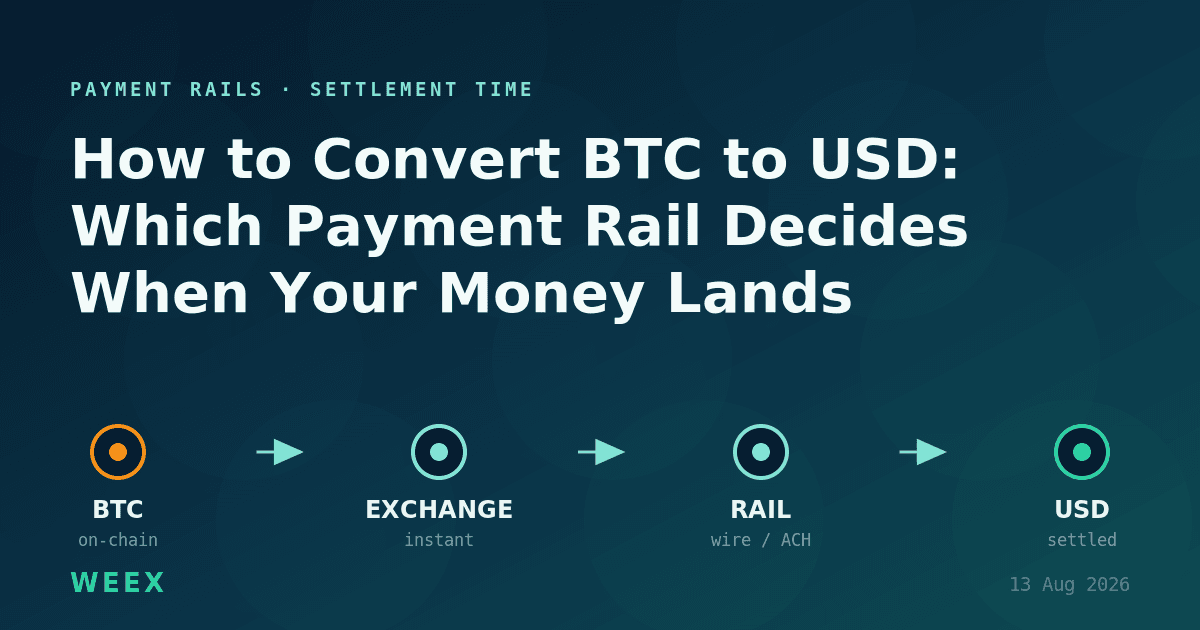
Converting BTC to USD takes two separate steps: the trade, which clears in seconds, and the payout, which does not. Selling is fast on any exchange. Getting dollars into a bank account takes anywhere from instant to five business days, and which it is depends entirely on the US payment rail your provider uses. For the live rate, use the BTC to USD converter.
Almost every guide to this stops at "withdraw to your bank." That is the part where the money actually goes missing for days, and it is the part nobody itemises. So start there.
The Four US Rails That Move Your Dollars
The dollars leaving an exchange or payment partner travel on one of four American clearing networks. Your provider chooses; you rarely get to. But the choice sets your timing and your ceiling, and knowing which one you are on is the difference between calling support on Saturday and not.
| Rail | Settlement | Operating window | Per-payment limit |
|---|---|---|---|
| Same Day ACH | Same business day if the file makes a processing window | Business days only | $1M, rising to $10M on 17 Sep 2027 |
| Fedwire Funds Service | Same day, typically within the hour | 22 hours a day, 9 p.m. ET prior day to 7 p.m. ET; Mon–Fri | Set by your bank |
| RTP | Instant and final | 24/7/365, including weekends and bank holidays | $10M |
| FedNow | Instant and final | 24/7/365 | $10M network limit; banks may set lower |
Sources: Nacha press release, 27 Apr 2026; Federal Reserve Financial Services; The Clearing House, retrieved 13 Aug 2026.
Two things in that table matter more than the rest.
The first is that instant rails now carry serious size. The Clearing House raised the RTP per-transaction ceiling to $10 million, and the Federal Reserve lifted the FedNow network limit from $1 million to $10 million effective November 2025. A retail-sized Bitcoin conversion has not been rail-constrained for years — if you are waiting days, it is because your provider chose ACH, not because the amount was too large.
The second is the weekend. RTP and FedNow settle on Saturdays; Fedwire and ACH do not. That single fact explains most "why is my withdrawal stuck" complaints, and it is structural rather than a bank being slow. The Federal Reserve announced in October 2025 that it intends to expand Fedwire and the National Settlement Service to six days a week — Sunday through Friday, including weekday holidays — but implementation is targeted for 2028 or 2029, and participation will be voluntary. Note the shape of it: the expansion adds Sundays, not Saturdays. A Saturday-afternoon wire request will still be a Monday wire even after it lands.
How Long Does It Take to Convert BTC to USD?
The trade fills in seconds. The payout is the variable: instant on RTP or FedNow, same business day on a wire or Same Day ACH submitted before its cut-off, and one to several business days on standard ACH, which is the slow default most providers use unless you pick otherwise. A first withdrawal is usually the slowest of your life on any platform, because verification runs alongside it.
That last point is worth separating out. People blame the rail for delays that are actually compliance holds. If your dollars have not moved and the rail is instant, the money is sitting in a review queue, not in transit.
Converting BTC to USD: The Steps, and What to Check at Each One
- Fund the account. Send BTC from self-custody to your exchange deposit address, or trade from a balance already there. Before you broadcast, confirm the deposit address is a Bitcoin address and not a wrapped-BTC address on another chain — this is the single most expensive mistake in the process, and it is not reversible.
- Sell BTC into a dollar-denominated asset. On the BTC/USDT spot market this is a normal sell order. Check whether you are taking or making liquidity before you confirm; a market order is always a taker order and always pays the higher fee.
- Verify the fill, not the quote. The number shown before you press the button is a quote. The number that matters is the fill. On a liquid pair these are close; on a large order they diverge.
- Choose the payout method. This is where you pick your rail, usually implicitly. If the provider offers a wire and an ACH option, you are choosing between same-day and multi-day.
- Clear verification before you need the money. Identity checks bind on the first withdrawal, not on the deposit or the trade. Complete them in advance and the payout is a formality.
Where the Money Goes on a 0.1 BTC Conversion
Here is the full chain on a real amount, computed line by line. As of 13 August 2026, WEEX quoted 1 BTC at 63,506.94 USD, so 0.1 BTC carried a reference value of $6,350.69.
| Line | Amount | Note |
|---|---|---|
| Starting balance | 0.1 BTC | $6,350.69 at 63,506.94 USD/BTC, 13 Aug 2026 |
| On-chain deposit fee | ≈ $0.09 | ~141 sats at 1 sat/vB |
| Spot taker fee (0.1%) | −$6.35 | WEEX published spot trading fee |
| Proceeds | ≈ 6,352 USDT | Before the fiat leg |
| Dollar value at 0.9988 | $6,344.34 | USDT quoted at 0.9988 USD, 13 Aug 2026 |
| Off-ramp fee | Varies | The one line you must look up for your own provider |
The on-chain leg was almost free on that date. Mempool.space's recommended fee rate was 1 satoshi per vbyte across every confirmation target on 13 August 2026, and a typical single-input, two-output SegWit spend runs about 141 vbytes — roughly 141 satoshis, or nine cents at that day's rate. That is a temporary condition, not a property of Bitcoin, and the arithmetic flips hard on small amounts. The same 141-vbyte transaction at 100 sat/vB costs 14,100 satoshis, about $8.95, which is 14% of a 0.001 BTC conversion. Converting dust during a fee spike is how people quietly lose a tenth of their position to the network.
Scale up tenfold and the mix inverts. On 1 BTC the trading fee becomes about $63.50 while the network fee stays at nine cents; a flat off-ramp charge that costs 0.4% on a $6,350 payout costs 0.04% on a $63,500 one. Percentage fees punish size, flat fees punish smallness, and the crossover is the only reason to think about batching at all.
Why the Stablecoin Leg Costs More Than the Trading Fee
Most conversion guides treat a dollar stablecoin as a dollar. It is not, and on this pair the gap is the largest controllable cost in the chain.
WEEX quoted USDT at 0.9988 USD on 13 August 2026 — a 12-basis-point discount to par. On the 6,352 USDT from the worked example above, that is $7.62. Small. But the same page recorded a 90-day low of 0.9895, and at that rate the identical balance is worth $6,285.27 rather than $6,344.34. A $59 swing, against a trading fee of $6.35.
The better reading is that the peg gap is not a fee at all — it is a market price, which is exactly why it is easy to miss. It does not appear on a fee schedule, and no confirmation screen names it. On a 1 BTC conversion the same spread between 0.9988 and 0.9895 is worth about $591. If you are moving size, checking the stablecoin's quote against par is worth more than optimising your fee tier.
What Goes Wrong: Holds, Wrong Networks, and the Saturday Gap
A first withdrawal sits in review. Identity verification binds when funds try to leave, not when they arrive. Complete it before the money matters to you.
The transfer went out on the wrong network. Sending Bitcoin to an address for a wrapped or bridged version of BTC on another chain, or the reverse, is generally unrecoverable. Confirm the chain, not just the ticker.
The received amount does not match the quote. The rate moved between quote and fill. On a volatile day this is ordinary; on a thin book it can be substantial.
The payout is under the minimum. Providers set per-transaction minimums that small conversions fall below, which is a separate constraint from whether the amount survives the fees.
It is Saturday. Covered above, and it will remain true through the end of the decade on Fedwire and ACH.
The daily cap bit before the per-transaction cap. These are different limits. A payout can clear the per-payment ceiling and still fail because the day's cumulative allowance is exhausted.
BTC to USD, or BTC to a Stablecoin?
Converting to dollars ends your exposure to crypto price movement and puts the value somewhere you can spend it, at the cost of a payout rail, a payout fee, and — in many jurisdictions — a disposal that may be a taxable event. Treatment varies by country and by circumstance, so confirm yours locally rather than assuming.
Converting to a dollar stablecoin instead keeps the value inside the crypto system, settles instantly, and skips the banking rail entirely. It also keeps you holding an instrument that traded at 0.9988 rather than 1.0000 on 13 August 2026 and dipped to 0.9895 within the prior ninety days, plus the issuer's own credit and redemption risk.
Neither is the correct answer in general. The honest test is narrow: if you need the money in a bank within days, the rail question decides everything and the stablecoin route is a detour. If you do not, the stablecoin route removes the slowest and least predictable part of the chain, and the peg is the price of that.
For the live rate before you commit to either, the BTC to USD converter carries the current number; the figures in this article are bound to 13 August 2026 and will drift.
FAQ
1. How long does it take for BTC to USD proceeds to reach my bank?
Instant on RTP or FedNow, which run 24/7/365. Same business day on a wire submitted inside Fedwire's operating window, which runs 22 hours a day from 9 p.m. ET the prior day to 7 p.m. ET, Monday to Friday. Longer on standard ACH. Your provider chooses the rail, so ask which one before you assume.
2. Why did my withdrawal stall over the weekend?
Fedwire and ACH do not settle on Saturdays. RTP and FedNow do. The Federal Reserve intends to extend Fedwire to Sunday–Friday operation in 2028 or 2029, which will not change Saturdays.
3. Is converting a very small amount of BTC worth it?
It depends almost entirely on Bitcoin's fee market at that moment. At 1 sat/vB, the level recorded on 13 August 2026, a typical transaction costs about nine cents and small conversions survive comfortably. At 100 sat/vB the same transaction costs roughly $8.95, which consumes 14% of a 0.001 BTC conversion.
4. Why is the amount I received lower than the amount I was quoted?
A quote is indicative; a fill is what executed. The rate can move between the two, and on a large order relative to available depth the order fills across multiple price levels.
5. Does converting BTC to USD create a tax liability?
Disposing of a crypto asset for fiat is treated as a taxable event in many jurisdictions, but treatment, thresholds and reporting differ substantially by country. Verify the position where you file rather than generalising from another market.
6. Should I convert to USD or hold a dollar stablecoin instead?
That depends on whether you need bank access and on what timeline, which only you can answer. What is measurable is the cost difference: on the 13 August 2026 quotes above, the stablecoin route avoided the banking rail but carried a 12-basis-point discount to par, against a 90-day low of 0.9895.
7. What is the largest single payout I can receive?
The rail ceilings are $10 million on both RTP and FedNow, and $1 million on Same Day ACH, rising to $10 million on 17 September 2027. In practice your provider's and your bank's own limits bind long before the network's do.
Risk Warning
Bitcoin's price is volatile, and the amount of USD you receive can differ from the amount quoted because the rate moves between quote and fill. Bitcoin transactions are irreversible: sending funds to an address on the wrong network or an incorrect address generally means the funds cannot be recovered. Fixed network and payout fees consume a disproportionate share of small conversions, particularly when Bitcoin fee rates are elevated. Dollar-denominated stablecoins trade at market prices that can and do sit below par, and carry issuer, redemption and counterparty risk distinct from holding bank deposits. Identity verification requirements, per-transaction minimums, and daily and per-payment limits can delay or block a withdrawal. Bank settlement on ACH and Fedwire does not occur on weekends or holidays. Converting crypto to fiat may be a taxable event depending on your jurisdiction; confirm your local treatment. All rates, fees and limits in this article were retrieved on 13 August 2026 and change over time.
This content is provided for general informational purposes only and doesn't constitute financial, investment, legal, or tax advice. Any events, rewards, online promotions, or related information mentioned herein should not be considered a recommendation, solicitation, or invitation to purchase, sell, trade, or otherwise deal in any crypto assets. Crypto assets are highly volatile and may result in loss. The availability of WEEX services, products, and related events may vary by region. You are responsible for ensuring that your participation is in accordance with applicable local laws and regulations.
You may also like

SpaceX Stock Could Be Worth Tens of Trillions in the 2030s: What the Mach33 Forecast Actually Claims
SpaceX Stock Has 66% Upside According to Wall Street: What the $231 Consensus Target Actually Requires

Morgan Stanley Says SpaceX Stock Can More Than Double: What the Overweight Thesis Actually Requires

SpaceX Stock Price Targets Range From $62 to $800: What the Analyst Disagreement Actually Reveals

XST Coin vs Akash Network: How Two AI Infrastructure Tokens Compare

XST Coin Tokenomics Explained: What 1 Billion Supply and 100% Circulation Actually Mean
How to Sell XST Coin: When and How to Exit Your XSolut Position

XST Ticker Confusion: Stealth Coin vs XSolut — Which One Are You Actually Buying
XST Coin Has Rallied More Than 600% From Its Lows: What Happens to Low-Cap Tokens After a Parabolic Move

Is NBIS Stock a Buy After Falling From Its All Time High? What the $37 Billion RPO Actually Implies

Nebius Stock Surges After Q2 Earnings: What 454% Revenue Growth and a $37 Billion Backlog Actually Mean
What Is XST Coin? A $54M Valuation on $760,000 of Liquidity

United States Water Reserve Coin: 98% Down and $1,053 Deep
Cisco Stock After Q4 FY26: Record AI Orders, Thinner Margins
Can You Buy Anthropic Stock? The Confidential Filing, the SPVs and Anthropic's Own Warning
Is OpenAI Publicly Traded? The Foundation That Controls It, and the Ticker That Isn't Theirs
Anduril Stock and the Anduril IPO: What the Company Says, and What Is Actually on File

How to Build a Crypto Trading Bot With WEEX API: A Beginner’s Guide
Crypto Quantitative Trading Tools: How Data, Backtesting, and APIs Build Automated Strategies
How Much Money Do You Need to Start Crypto Quantitative Trading?
REST API vs WebSocket API for Crypto Trading: What’s the Difference?
How to Secure a Crypto Trading Bot? API Key Safety Guide
What Is Crypto Arbitrage Trading? How Do Arbitrage Bots Work?
How to Use Crypto Trading APIs? A Beginner’s Guide
What Is a Grid Trading Bot? How Does Crypto Grid Trading Work?
Kioxia Stock and SK Hynix: What Rivals Sharing the Same Shareholder Actually Means
Is HIMS Stock a Buy After the Earnings Selloff? What the Full-Year Guidance Raise Actually Implies
ASTS Stock Falls After Missing Q2 Estimates: What the Revenue Miss and Japan Launch Actually Mean
Intel Stock Is Up Over 170% in 2026: What the AI Foundry Turnaround Actually Required
Intel Stock Sale Draws Over $100 Billion in Demand: What the 5x Oversubscription Actually Signals
SpaceX Stock Could Be Worth Tens of Trillions in the 2030s: What the Mach33 Forecast Actually Claims
SpaceX Stock Has 66% Upside According to Wall Street: What the $231 Consensus Target Actually Requires
Morgan Stanley Says SpaceX Stock Can More Than Double: What the Overweight Thesis Actually Requires
SpaceX Stock Price Targets Range From $62 to $800: What the Analyst Disagreement Actually Reveals
XST Coin vs Akash Network: How Two AI Infrastructure Tokens Compare
XST Coin Tokenomics Explained: What 1 Billion Supply and 100% Circulation Actually Mean
Contents
Popular coins
Latest articles







