
United States Water Reserve Coin: 98% Down and $1,053 Deep

 Prefer us on Google

The United States Water Reserve coin traded at $0.0006133 on August 13, 2026 — 98.1% below the $0.03260 high CoinGecko recorded on July 25, less than three weeks earlier. That drawdown is not the interesting number.
The interesting number is $1,053.38. That is how much sell-side value the token's only live market could absorb before the price moved 2% against the seller, measured on August 13, 2026. Against a $610,654 market capitalization, the entire tradable buffer at a 2% price concession was roughly 0.17% of the token's stated value.
Most coverage of this token argues about whether the name is misleading. That argument is settled — the project's own site disclaims any government affiliation, and WEEX has already published a full legitimacy review of USWR. The unsettled question for anyone still holding is narrower and more expensive: can you get out at anything close to the quoted price?
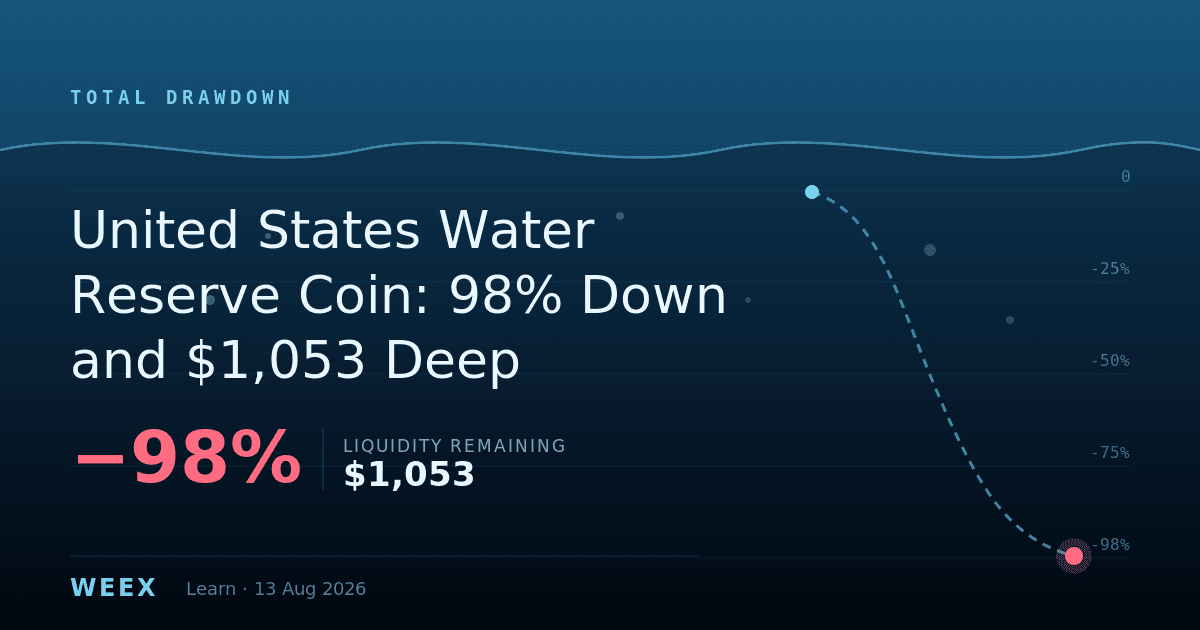
United States Water Reserve Coin Price: The Record Since July
Here is what the token actually did, as tracked by CoinGecko on August 13, 2026.
| Metric | Value (Aug 13, 2026) |
|---|---|
| Price | $0.0006133 |
| 24h change | +36.2% |
| 7d change | −26.4% |
| 30d change | −97.6% |
| Market cap / FDV | $610,654 (identical — Mcap/FDV = 1) |
| 24h volume | $9,320 |
| CoinGecko rank | #3,070 |
| Recorded high | $0.03260 (Jul 25, 2026) |
| Recorded low | $0.0003608 (Jul 25, 2026) |
| Circulating supply | 999,997,000 of 1,000,000,000 max |
| Contract (Solana) | 4D8qUHm334fxqeTauPvF8gQ7fYgrD4Mpmb1Wy6ftUSWR |
Two details in that table do more work than the headline price.
First, the recorded high and the recorded low share a date. July 25, 2026 contained both the peak and something close to the floor. A token that traverses its full lifetime range inside a single session is not being repriced by changing fundamentals; it is being moved by a small number of participants across a shallow pool.
Second, market cap and fully diluted valuation are the same figure. Nearly the whole billion-token supply is already circulating, so there is no unlock overhang to blame for the decline and no future dilution to price in. Whatever happened in late July happened in the open market.
The +36.2% single-day gain on August 13 is the kind of move that reads as a recovery on a chart and means very little in practice. On $9,320 of daily volume, a 36% bounce can be produced by a few thousand dollars of buying.
The Number That Matters More Than USWR's Price
On August 13, 2026, the United States Water Reserve coin traded on exactly one venue: the USWR/WSOL pool on Meteora DAMM V2, a Solana automated market maker. That single pair accounted for 100% of tracked volume. There is no centralized exchange order book, no second pool to arbitrage against, and no alternative quote if that pool thins out.
CoinGecko's depth measurement for that pool, same date:
| Order book measure | Value | As % of $610,654 market cap |
|---|---|---|
| +2% depth (buy side) | $1,056.56 | 0.17% |
| −2% depth (sell side) | $1,053.38 | 0.17% |
| Bid-ask spread | 0.61% | — |
| 24h volume | $9,320 | 1.53% |
Read the third column slowly. A holder who bought $5,000 of USWR is sitting on a position roughly five times larger than the amount of selling the market absorbs at a 2% concession. Exiting that position in one transaction does not cost 2%. Depth on an AMM curve degrades non-linearly — the further you push, the worse each incremental token fills — so a sale that size walks the price down substantially, and the fill you receive bears no resemblance to the number on the price page. That gap is slippage, and in a single-pool token it is the dominant cost of the trade.
This is where retail traders in tokens like this usually lose money, and it is rarely the part they were watching. They are not wrong about the narrative — AI data centers really do consume water, and water really is a constrained resource. They are wrong about the assumption that a quoted price is an achievable price. The quote reflects the last marginal trade. The market cap reflects that marginal trade multiplied by a billion tokens that were never tested against a bid.
Four Contracts, One Name: Which USWR Are You Looking At?
Searching "United States Water Reserve coin" on August 13, 2026 returns price pages for several different assets with near-identical names across at least two blockchains:
| Listing name | Chain | Address (partial) |
|---|---|---|
| United States Water Reserve (USWR) | Solana | 4D8qUHm...ftUSWR |
| United States Water Reserve (USWR) | Solana | 4UKg8Ds...SKRYpump |
| United States Water Reserve (UWSR) | Base | 0xa51953...15640a |
| US WATER RESERVE (USWR) | Base | 0x0ca755...cbe0c4 |
Note the third row: the ticker is UWSR, not USWR — two letters transposed. Note the fourth: a slightly different project name entirely. Only the first has meaningful tracked liquidity.
The practical consequence is that a trader who searches the token name, clicks the first "how to buy" result, and swaps against whatever address that page surfaces has a real chance of buying something other than the token they read about. Copycat tokens are not a hypothetical risk here — they are already indexed on mainstream price sites. Verify the contract address against the project's own channels before approving any swap, and treat a "buy" button on an aggregator page as an unverified pointer rather than a source of truth.
Does the United States Water Reserve Coin Own Any Water?
No. Holders receive no water rights, no reservoir claim, no revenue from utilities or infrastructure, and no exposure to water commodity pricing. The project site (uswr.ai) states it is not affiliated with any U.S. government agency or with the institutions its marketing references. CoinGecko classifies the asset under Solana meme coins and appends its own disclaimer that the token is not affiliated with the United States Government.
The AI-water thesis behind the branding is real. Large-scale model training and inference drive meaningful cooling demand, and evaporative cooling consumes water. But holding a meme coin named after that thesis is not exposure to it. If the AI-water bottleneck tightens tomorrow, nothing in this token's cash flows changes, because there are none. It is a bet on attention, priced by a single Solana pool.
USWR Price Prediction Math: What Each Target Requires
Several forecast sites publish USWR targets, some of them well above $1. Rather than argue with the forecasts, it is more useful to translate each target into the market capitalization it implies at the current 1 billion supply.
| Target price | Implied market cap | Multiple from $0.0006133 |
|---|---|---|
| $0.001 | $1.0M | 1.6x |
| $0.0033 (one-tenth of the July high) | $3.3M | 5.3x |
| $0.03260 (July 2026 high) | $32.6M | 53x |
| $0.10 | $100M | 163x |
| $1.00 | $1.0B | 1,631x |
A $1 target is a claim that a single-pool Solana meme token reaches a $1 billion valuation — territory occupied by established Layer-1s and major DeFi protocols. That is not a forecast so much as a placeholder number generated to fill a page.
The more defensible framing: even the modest scenarios require sustained new capital entering a pool that currently absorbs about $1,000 before moving 2%. Price targets are cheap. Depth is what has to exist for them to mean anything.
How to Buy the United States Water Reserve Coin — and Why the Exit Comes First
Acquiring USWR is mechanically simple: a Solana wallet, SOL for gas and for the swap, and a DEX route into the Meteora pool. That is not the hard part, and treating it as the hard part is the mistake.
Before any swap, three checks are worth more than the trade itself:
- Size the position against depth, not against your portfolio. If your intended position exceeds the pool's −2% depth, you have no realistic single-transaction exit. Plan to scale out over multiple transactions, or size down.
- Confirm the exact contract address from the project's own channels, not from a search result. See the collision table above.
- Set a slippage tolerance deliberately. A high tolerance guarantees the swap executes; it does not guarantee a price you would have accepted.
Traders who want narrative exposure with a functioning exit generally find it in liquid majors with multiple venues and deep order books rather than in single-pool micro-caps. Deep, multi-venue pairs on WEEX Markets illustrate the contrast plainly: the question there is what price you get, not whether a price exists at your size.
Market View
The United States Water Reserve coin is a clean case study in the difference between a price and a market. The narrative was well-constructed, the launch mechanics were tidier than most, and none of that prevented a 98% drawdown in under three weeks.
What the token lacks is not a story. It is a second buyer. One pool, roughly $1,000 of two-percent depth, and a supply that is already fully circulating leave no structural mechanism to absorb selling. For a short-cycle trader who understands that and sizes accordingly, it is a momentum instrument. For anyone treating it as a position, the exit is the trade — and it is priced far worse than the chart suggests. WEEX's earlier briefing on what USWR traders should verify covers the on-chain checks that pair with this liquidity view.
FAQ
1. What is the United States Water Reserve coin?
It is a Solana SPL meme token, ticker USWR, branded around the idea that AI data centers will strain water supplies. It confers no water rights, infrastructure claim, or government affiliation.
2. Why did the United States Water Reserve coin drop 98%?
The token peaked at $0.03260 on July 25, 2026 and traded at $0.0006133 on August 13, 2026. With one liquidity pool and no unlock schedule to blame, the decline reflects ordinary selling into a market too thin to absorb it.
3. Where does USWR actually trade?
As of August 13, 2026, on a single venue: the USWR/WSOL pool on Meteora DAMM V2, which carried 100% of tracked volume. There is no centralized exchange listing for this contract.
4. How much can I sell without moving the price?
Roughly $1,053 at a 2% price concession, measured August 13, 2026. Larger sales walk further down the AMM curve and fill progressively worse.
5. What is the correct USWR contract address?
The CoinGecko-tracked Solana contract is 4D8qUHm334fxqeTauPvF8gQ7fYgrD4Mpmb1Wy6ftUSWR. At least three other tokens with near-identical names exist on Solana and Base — verify independently before swapping.
6. Can the United States Water Reserve coin reach $1?
$1 implies a $1 billion market cap on the 1 billion token supply, roughly 1,631x the August 13, 2026 price, in an asset with about $9,300 of daily volume. Treat published targets at that level as unsupported.
Risk Warning
Crypto assets are highly volatile and may result in partial or total loss of funds. The specific risks in this token are concentrated rather than general: a single liquidity pool with roughly $1,053 of depth at a 2% concession means exit prices can differ sharply from quoted prices, and that pool can be withdrawn or drained without notice. At least four separate contracts across Solana and Base carry near-identical names, so buying the wrong address is a live path to total loss. The token has no revenue, no asset backing, no water rights, and no government affiliation, so there is no valuation floor beneath sentiment. All figures above are dated August 13, 2026 and change continuously — verify live price, depth, and contract data before acting on any of them.
This content is provided for general informational purposes only and doesn't constitute financial, investment, legal, or tax advice. Any events, rewards, online promotions, or related information mentioned herein should not be considered a recommendation, solicitation, or invitation to purchase, sell, trade, or otherwise deal in any crypto assets. Crypto assets are highly volatile and may result in loss. The availability of WEEX services, products, and related events may vary by region. You are responsible for ensuring that your participation is in accordance with applicable local laws and regulations.
You may also like

SpaceX Stock Could Be Worth Tens of Trillions in the 2030s: What the Mach33 Forecast Actually Claims
SpaceX Stock Has 66% Upside According to Wall Street: What the $231 Consensus Target Actually Requires

Morgan Stanley Says SpaceX Stock Can More Than Double: What the Overweight Thesis Actually Requires
SpaceX Stock Price Targets Range From $62 to $800: What the Analyst Disagreement Actually Reveals
XST Coin vs Akash Network: How Two AI Infrastructure Tokens Compare

XST Coin Tokenomics Explained: What 1 Billion Supply and 100% Circulation Actually Mean
How to Sell XST Coin: When and How to Exit Your XSolut Position
XST Ticker Confusion: Stealth Coin vs XSolut — Which One Are You Actually Buying
XST Coin Has Rallied More Than 600% From Its Lows: What Happens to Low-Cap Tokens After a Parabolic Move

Is NBIS Stock a Buy After Falling From Its All Time High? What the $37 Billion RPO Actually Implies

Nebius Stock Surges After Q2 Earnings: What 454% Revenue Growth and a $37 Billion Backlog Actually Mean
How to Convert BTC to USD: Which Payment Rail Decides When Your Money Lands
What Is XST Coin? A $54M Valuation on $760,000 of Liquidity
Cisco Stock After Q4 FY26: Record AI Orders, Thinner Margins

Can You Buy Anthropic Stock? The Confidential Filing, the SPVs and Anthropic's Own Warning
Is OpenAI Publicly Traded? The Foundation That Controls It, and the Ticker That Isn't Theirs
Anduril Stock and the Anduril IPO: What the Company Says, and What Is Actually on File
How to Build a Crypto Trading Bot With WEEX API: A Beginner’s Guide
Crypto Quantitative Trading Tools: How Data, Backtesting, and APIs Build Automated Strategies
How Much Money Do You Need to Start Crypto Quantitative Trading?
REST API vs WebSocket API for Crypto Trading: What’s the Difference?
How to Secure a Crypto Trading Bot? API Key Safety Guide
What Is Crypto Arbitrage Trading? How Do Arbitrage Bots Work?
How to Use Crypto Trading APIs? A Beginner’s Guide
What Is a Grid Trading Bot? How Does Crypto Grid Trading Work?
Kioxia Stock and SK Hynix: What Rivals Sharing the Same Shareholder Actually Means
Is HIMS Stock a Buy After the Earnings Selloff? What the Full-Year Guidance Raise Actually Implies
ASTS Stock Falls After Missing Q2 Estimates: What the Revenue Miss and Japan Launch Actually Mean
Intel Stock Is Up Over 170% in 2026: What the AI Foundry Turnaround Actually Required
Intel Stock Sale Draws Over $100 Billion in Demand: What the 5x Oversubscription Actually Signals
SpaceX Stock Could Be Worth Tens of Trillions in the 2030s: What the Mach33 Forecast Actually Claims
SpaceX Stock Has 66% Upside According to Wall Street: What the $231 Consensus Target Actually Requires
Morgan Stanley Says SpaceX Stock Can More Than Double: What the Overweight Thesis Actually Requires
SpaceX Stock Price Targets Range From $62 to $800: What the Analyst Disagreement Actually Reveals
XST Coin vs Akash Network: How Two AI Infrastructure Tokens Compare
XST Coin Tokenomics Explained: What 1 Billion Supply and 100% Circulation Actually Mean


