
Crypto Quantitative Trading Tools: How Data, Backtesting, and APIs Build Automated Strategies

 Prefer us on Google
Crypto quantitative trading is often misunderstood as simply using a trading bot to buy and sell automatically. In reality, a complete quantitative trading system is built from multiple components, including market data, strategy development, testing tools, and execution infrastructure.
For individual traders, the biggest challenge is usually not finding a “powerful” tool, but understanding what each tool is responsible for.
A reliable quantitative workflow usually follows this structure:
Collect accurate data → Develop a strategy → Backtest performance → Connect execution tools → Monitor risk
Each part solves a different problem. Without reliable data, a strategy may generate incorrect signals. Without backtesting, a profitable-looking idea may fail in real markets. Without proper execution tools, even a good strategy may not perform as expected.
Market Data Tools: The Foundation of Quantitative Trading
Unlike manual traders who may rely on charts and market sentiment, quantitative systems require structured information that can be analyzed by programs.
Common data includes:
- Price history;
- Candlestick data;
- Trading volume;
- Order book information;
- Market depth.
The quality of data directly affects strategy results. For example, a strategy tested with incomplete price data may show unrealistic performance because the model is learning from inaccurate information.
For beginners, understanding data quality is often more important than immediately building complex algorithms. A simple strategy using reliable data can be more useful than an advanced model built on poor information.
Python: A Practical Starting Point for Building Strategies
Python is one of the most commonly used programming languages in quantitative trading because it combines simplicity with powerful data analysis capabilities.
In crypto trading, Python is often used to:
- Process market data;
- Calculate indicators;
- Test trading ideas;
- Connect with exchange APIs;
- Automate repetitive operations.
For example, a beginner may create a simple trend-following strategy:
“If the short-term moving average crosses above the long-term moving average, generate a buy signal.”
Python can calculate these indicators, test historical results, and connect the strategy with an exchange execution system.
However, programming is only a tool. Writing more code does not automatically create a better strategy. The important part is whether the trading logic is reasonable and tested under different market conditions.
TradingView and Strategy Research Tools: Turning Ideas Into Testable Rules
Many traders start quantitative research with charting platforms such as TradingView. These tools help users explore market behavior and transform trading ideas into measurable rules.
For example, instead of saying:
“Bitcoin usually rises after strong momentum.”
A quantitative approach asks:
“How often did this happen historically, and what was the average result?”
This shift from opinions to measurable rules is one of the key differences between manual trading and quantitative trading.
However, charting tools alone are not complete automated systems. They help with analysis and signal creation, while execution usually requires additional technology.
Backtesting Tools: The Difference Between an Idea and a Tested Strategy
Backtesting is one of the most important steps in quantitative trading.
A backtest applies a strategy to historical market data to evaluate how it would have performed in the past.
However, beginners often misunderstand backtesting. A strategy with the highest historical return is not necessarily the best strategy.
A more meaningful evaluation should include:
| Metric | Why It Matters |
|---|---|
| Total return | Shows historical performance |
| Maximum drawdown | Measures the largest loss period |
| Trading frequency | Shows how often the strategy operates |
| Fees and slippage | Reflects real trading conditions |
For example, a strategy that earns 50% in backtesting but experiences a 40% drawdown may not be suitable for every trader.
A realistic backtest should include transaction costs and avoid excessive parameter adjustments, which can create overfitting.
Databases: Managing Data for Long-Term Strategy Development
As quantitative systems become more advanced, data management becomes increasingly important.
A database allows traders to store and organize:
- Historical market data;
- Strategy signals;
- Trading results;
- Performance records.
For example, when comparing several BTC trading strategies over multiple years, manually reviewing spreadsheets becomes inefficient.
A structured database makes it easier to analyze performance, identify problems, and improve strategies over time.
Trading APIs: Connecting Strategies With Real Market Execution
A quantitative strategy can decide when to trade, but it still needs a connection to an exchange to execute orders.
This is where trading APIs become essential.
An API acts as the communication layer between a trading program and an exchange. The strategy determines the trading decision, while the API handles the technical process of sending requests and receiving responses.
A typical automated workflow looks like:
The program receives market data, analyzes trading conditions, generates a signal, and sends an order request through the API.
For developers building automated trading systems, exchange APIs provide access to market data and trading functions.
For example, developers can use the WEEX API to connect their own trading programs with exchange services. The integration process usually involves reviewing API documentation, creating an API Key, connecting market data interfaces, and testing order execution.
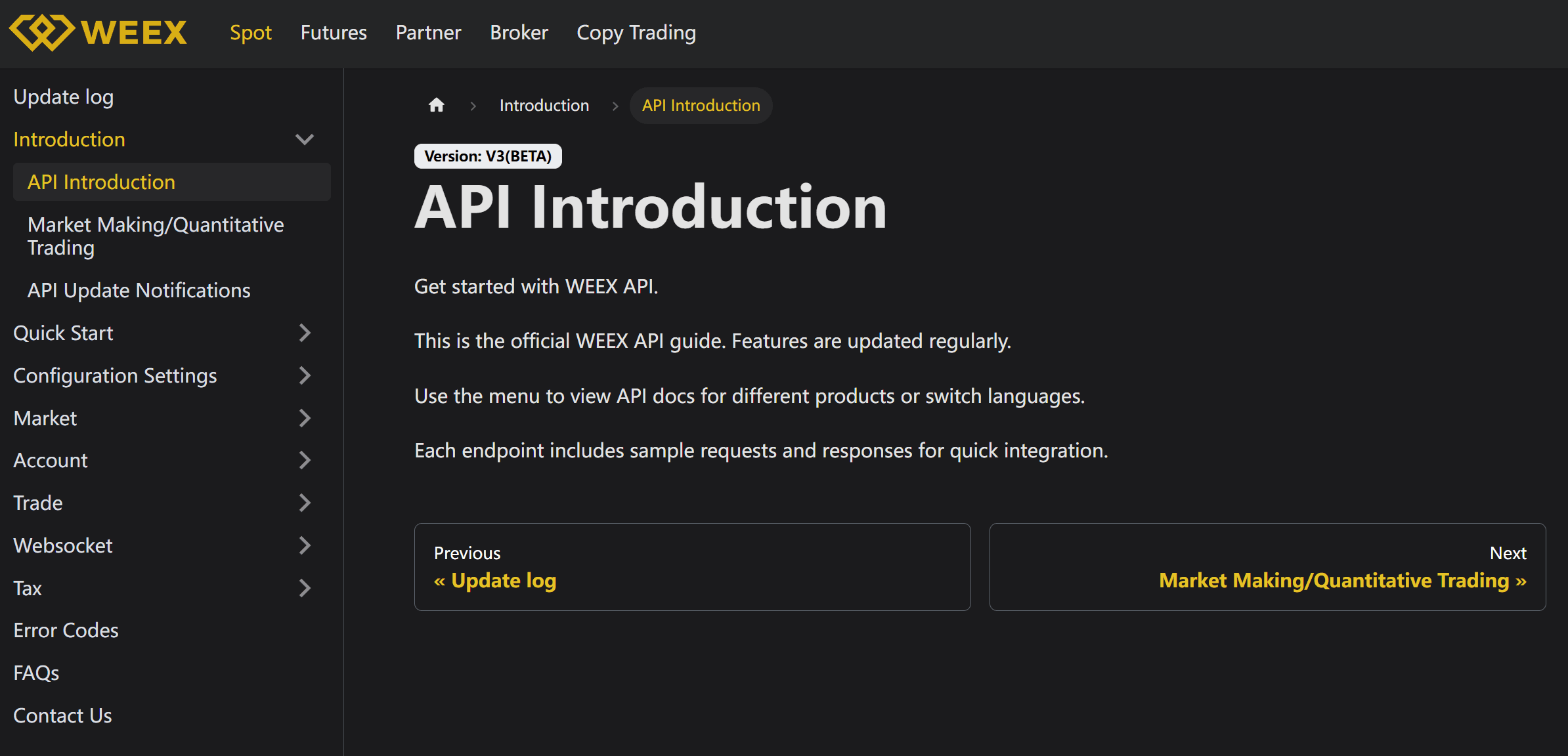
During development, several technical details are important. Trading programs should use the correct trading pair format, such as BTCUSDT, manage API permissions carefully, protect API Secret information, and handle possible errors or request limitations.
These details may seem small, but they can directly affect whether an automated system works reliably.
An API improves execution efficiency, but it does not create trading advantages by itself. The strategy, risk controls, and testing process remain the foundation of the system.
How Should Beginners Choose Crypto Quantitative Trading Tools?
Beginners often make the mistake of searching for the “best” trading bot or the most advanced software.
A better approach is to build knowledge step by step. Start with market data and basic strategy concepts. Then learn how to test ideas using backtesting tools. After understanding the strategy logic, explore automation through APIs.
This approach reduces unnecessary complexity and helps traders understand why a system works instead of simply relying on a tool.
Common Mistakes When Using Quantitative Trading Tools
One common mistake is focusing too much on automation speed while ignoring strategy quality.
A faster system cannot fix a poor trading model.
Another mistake is trusting backtest results without checking whether they include realistic conditions such as fees, liquidity, and market changes.
Security is also important. API credentials should always be protected, and users should avoid granting unnecessary permissions to trading applications.
Conclusion
Crypto quantitative trading tools are not a single product but a complete ecosystem that includes data sources, programming languages, research platforms, backtesting systems, databases, and trading APIs.
Each tool plays a different role:
Data helps strategies make decisions.
Backtesting helps evaluate ideas.
APIs connect strategies with exchanges.
For beginners, the goal should not be building the most complicated trading system. A simple, well-tested, and clearly understood system is often more valuable than a complex model that cannot be properly evaluated.
Quantitative trading is ultimately about turning market ideas into measurable rules and using technology to execute those rules more consistently.
This content is provided for general informational purposes only and doesn't constitute financial, investment, legal, or tax advice. Any events, rewards, online promotions, or related information mentioned herein should not be considered a recommendation, solicitation, or invitation to purchase, sell, trade, or otherwise deal in any crypto assets. Crypto assets are highly volatile and may result in loss. The availability of WEEX services, products, and related events may vary by region. You are responsible for ensuring that your participation is in accordance with applicable local laws and regulations.
You may also like

SpaceX Stock Could Be Worth Tens of Trillions in the 2030s: What the Mach33 Forecast Actually Claims
SpaceX Stock Has 66% Upside According to Wall Street: What the $231 Consensus Target Actually Requires

Morgan Stanley Says SpaceX Stock Can More Than Double: What the Overweight Thesis Actually Requires

SpaceX Stock Price Targets Range From $62 to $800: What the Analyst Disagreement Actually Reveals

XST Coin vs Akash Network: How Two AI Infrastructure Tokens Compare

XST Coin Tokenomics Explained: What 1 Billion Supply and 100% Circulation Actually Mean
How to Sell XST Coin: When and How to Exit Your XSolut Position

XST Ticker Confusion: Stealth Coin vs XSolut — Which One Are You Actually Buying

XST Coin Has Rallied More Than 600% From Its Lows: What Happens to Low-Cap Tokens After a Parabolic Move

Is NBIS Stock a Buy After Falling From Its All Time High? What the $37 Billion RPO Actually Implies

Nebius Stock Surges After Q2 Earnings: What 454% Revenue Growth and a $37 Billion Backlog Actually Mean
How to Convert BTC to USD: Which Payment Rail Decides When Your Money Lands
What Is XST Coin? A $54M Valuation on $760,000 of Liquidity

United States Water Reserve Coin: 98% Down and $1,053 Deep
Cisco Stock After Q4 FY26: Record AI Orders, Thinner Margins
Can You Buy Anthropic Stock? The Confidential Filing, the SPVs and Anthropic's Own Warning
Is OpenAI Publicly Traded? The Foundation That Controls It, and the Ticker That Isn't Theirs
Anduril Stock and the Anduril IPO: What the Company Says, and What Is Actually on File

How to Build a Crypto Trading Bot With WEEX API: A Beginner’s Guide
How Much Money Do You Need to Start Crypto Quantitative Trading?
REST API vs WebSocket API for Crypto Trading: What’s the Difference?
How to Secure a Crypto Trading Bot? API Key Safety Guide
What Is Crypto Arbitrage Trading? How Do Arbitrage Bots Work?
How to Use Crypto Trading APIs? A Beginner’s Guide
What Is a Grid Trading Bot? How Does Crypto Grid Trading Work?
Kioxia Stock and SK Hynix: What Rivals Sharing the Same Shareholder Actually Means
Is HIMS Stock a Buy After the Earnings Selloff? What the Full-Year Guidance Raise Actually Implies
ASTS Stock Falls After Missing Q2 Estimates: What the Revenue Miss and Japan Launch Actually Mean
Intel Stock Is Up Over 170% in 2026: What the AI Foundry Turnaround Actually Required
Intel Stock Sale Draws Over $100 Billion in Demand: What the 5x Oversubscription Actually Signals
SpaceX Stock Could Be Worth Tens of Trillions in the 2030s: What the Mach33 Forecast Actually Claims
SpaceX Stock Has 66% Upside According to Wall Street: What the $231 Consensus Target Actually Requires
Morgan Stanley Says SpaceX Stock Can More Than Double: What the Overweight Thesis Actually Requires
SpaceX Stock Price Targets Range From $62 to $800: What the Analyst Disagreement Actually Reveals
XST Coin vs Akash Network: How Two AI Infrastructure Tokens Compare
XST Coin Tokenomics Explained: What 1 Billion Supply and 100% Circulation Actually Mean
Contents
Popular coins
Latest articles